

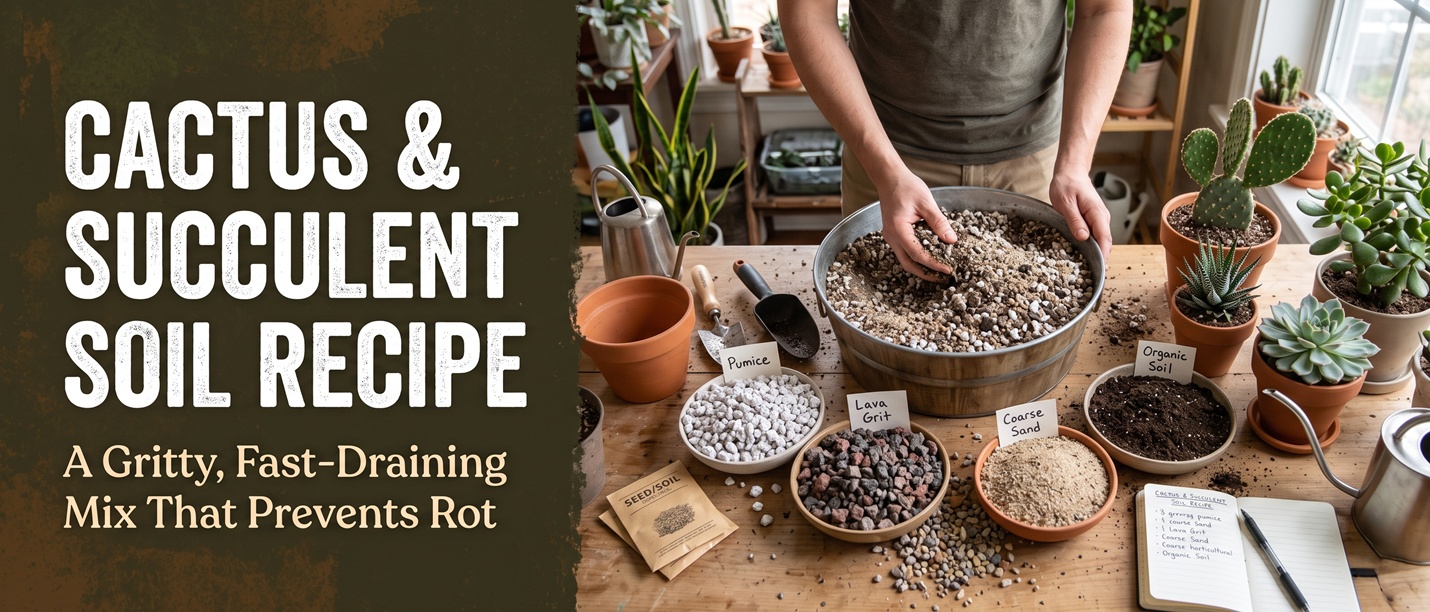
Why Store-Bought Cactus Soil Fails
Commercial cactus and succulent potting mixes are typically 70–80% peat moss with a sprinkling of perlite and sand. That formulation works for the first month, but peat breaks down quickly into a water-holding sludge that suffocates succulent roots. Most beginners who lose Echeverias, Haworthias, or Lithops to 'overwatering' are actually losing them to soil that holds moisture far longer than the plant can tolerate.
In habitat, cacti and succulents grow in mineral substrates — decomposed granite, volcanic pumice, gravelly scree — with almost zero organic matter. Their roots are designed to absorb water fast during brief rain events, then sit bone-dry for weeks. Replicating that environment in a pot is the key to keeping them alive long-term.
💡 Tip
If you can only remember one rule: succulent soil should be at least 50% inorganic mineral material by volume. Organic matter (coir, peat, compost) should never be more than half of the total mix.
The Core Gritty Succulent Recipe
This recipe works for almost all rosette-forming succulents (Echeveria, Sempervivum, Graptopetalum), leafy succulents (Haworthia, Gasteria, Aloe), and most cacti. It drains almost instantly — water runs through the pot in seconds — but a thin film of moisture clings to the pumice particles long enough for the roots to absorb what they need.
The standard gritty succulent mix:
- 2 parts pumice (3–6 mm) — the backbone; holds moisture on its surface while creating huge air pockets
- 1 part calcined clay (Turface MVP or Oil-Dri) — absorbs and releases water slowly, prevents compaction
- 1 part coco coir (rehydrated, squeezed nearly dry) — modest organic component for nutrient exchange
- 1 part perlite (coarse) — extra drainage, lightens the mix
For the most rot-prone plants — Lithops, Conophytum, Ariocarpus, and other mesembs — drop the coir to 0.5 part and add an extra part of pumice. For jungle cacti like Christmas cactus (Schlumbergera) and Easter cactus (Hatiora), increase coir to 1.5 parts and reduce pumice to 1.5 parts to better match their epiphytic habitat.
Pumice: The Single Most Important Ingredient
If you buy only one ingredient, make it pumice. Unlike perlite, pumice is heavy enough to stay mixed in the pot rather than floating to the surface, and it has a porous internal structure that holds both air and water simultaneously. Plant roots grow into and around the pumice particles, accessing moisture on demand without sitting in saturated soil.
Horticultural pumice is widely available online in grades from 1 mm (fines) to 15 mm (large). For succulents, the 3–6 mm grade is ideal — small enough to fit in smaller pots but large enough to create real air channels. A 10-litre bag lasts a typical collector more than a year and costs less than two nursery-potted succulents.
Substitutions When Pumice Is Unavailable
Perlite can substitute for pumice at a 1:1 ratio, though it will float and you may need to top-dress the pot with gravel to keep it in place. Calcined clay (sold as Turface, Oil-Dri, or kitty litter without additives) is a serviceable substitute that holds slightly more water than pumice. Decomposed granite, chicken grit, and coarse builder's sand all work as partial substitutes, though they reduce drainage and add weight to the pot.
Avoid aquarium gravel, pea gravel, and glass 'decorative pebbles' — these are non-porous and contribute nothing but weight. They will not hurt the plant, but they will not help either, and they make the pot surprisingly heavy to move.
⚠️ Warning
Do not use playground sand, beach sand, or any fine-grained sand. Fine sand fills the air spaces between larger particles and turns the mix into concrete. Only coarse builder's sand (1–2 mm particles) is acceptable, and even then only in small proportions.
How This Mix Changes Your Watering Routine
With a properly gritty mix, you can — and should — water thoroughly, soaking the entire pot until water streams from the drainage holes. There is no risk of overwatering a single watering event because the mix drains in seconds. The danger comes from watering too frequently, before the mix has fully dried.
In summer, water most succulents every 7–14 days depending on temperature. In winter, when days are short and growth is minimal, stretch intervals to 3–4 weeks or longer. Lithops and other mesembs may need water only two or three times between November and March. When in doubt, wait another week — a succulent can recover from drought far more easily than from excess water.
💡 Tip
Lift the pot after watering, then lift it again a week later. A well-draining gritty mix should feel dramatically lighter after 4–5 days. If the pot still feels heavy at day 7, your mix is too organic — add more pumice next time you repot.
Fertilizing in a Mineral Mix
Because this recipe is mostly mineral, it contains very little native nutrition. Feed succulents monthly during the active growing season (spring and summer in the northern hemisphere) with a balanced fertilizer at quarter strength. Look for a formulation with low nitrogen — anything labeled specifically for cacti and succulents will work, as will a standard tomato fertilizer diluted heavily. Stop feeding entirely in late autumn and winter.
Only logged-in users can comment
Sign in or create a free account to join the conversation — it takes less than a minute.