

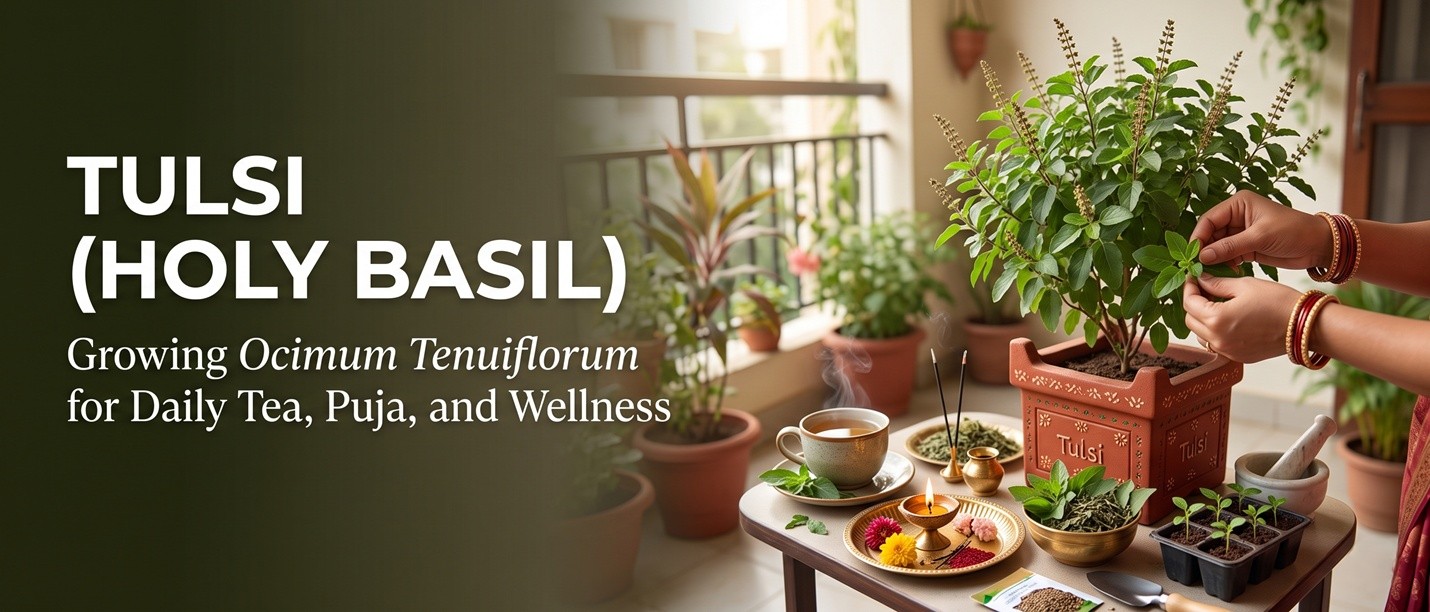
Why Tulsi Is More Than Just a Herb
Tulsi (Ocimum tenuiflorum, formerly Ocimum sanctum) is a sacred plant in Hinduism, revered as an earthly manifestation of the goddess Lakshmi and grown in almost every Hindu household courtyard. Beyond its religious significance, tulsi is one of the most important herbs in Ayurvedic medicine, where it has been used for over 3,000 years to support respiratory health, reduce stress, and boost immunity. Modern research has confirmed many of these traditional uses — tulsi contains compounds with documented adaptogenic, anti-inflammatory, antimicrobial, and antioxidant properties.
From a gardening perspective, tulsi is a perfect container plant. It is a perennial in tropical climates and an annual in temperate ones, growing to 60-90 cm tall with fragrant green or purple leaves and spikes of small purple flowers. It thrives in containers, responds enthusiastically to pruning (the more you harvest, the bushier it grows), and provides a daily supply of fresh leaves for tea, cooking, and puja. Once you grow tulsi, you will never stop — it becomes a daily ritual plant that connects you to centuries of tradition.
💡 Tip
Even if you are not Hindu or interested in Ayurveda, growing tulsi is worth it purely for the daily tea. A handful of fresh tulsi leaves steeped in hot water with a slice of ginger and a touch of honey is one of the most fragrant, calming herbal teas you can make at home. The flavor is somewhere between basil, pepper, and clove — unlike culinary basil, tulsi has a complex spiciness that makes it unsuitable for pesto but perfect for tea.
The Three Main Tulsi Varieties
Three main varieties of tulsi are cultivated, each with distinct characteristics and uses. Knowing which one you have (or want) matters because they have slightly different growth habits, flavors, and traditional uses. All three are Ocimum tenuiflorum and share the same care requirements; the differences are in appearance and flavor.
The three main tulsi varieties:
- Rama Tulsi (Ocimum tenuiflorum 'Rama') — green leaves and stems, mild flavor, most commonly grown for daily tea and puja, easiest to find as seeds or plants
- Krishna Tulsi (Ocimum tenuiflorum 'Krishna') — dark purple leaves and stems, sharper peppery flavor, considered most medicinally potent, slightly slower growing
- Vana Tulsi (Ocimum tenuiflorum 'Vana') — bright green leaves with lighter green stems, milder clove-like flavor, grows larger and more shrub-like, less commonly cultivated
- Kapoor Tulsi (Ocimum basilicum 'Kapoor') — technically a different species (annual basil, not true tulsi), much easier to grow in temperate climates, fragrant but lacks the medicinal potency of true tulsi
If you are growing tulsi for the first time, start with Rama Tulsi — it is the most forgiving, the most productive, and the most versatile. If you cannot find true tulsi seeds locally, Kapoor Tulsi (often sold simply as 'Holy Basil' in Western seed catalogs) is a reasonable substitute that grows easily in temperate climates, but be aware that it is not the same plant and lacks the medicinal potency of true Ocimum tenuiflorum.
Light and Temperature: The Heat Lover
Tulsi is a tropical plant that loves heat and sun. It needs at least 6-8 hours of direct sunlight per day to grow vigorously and produce the essential oils that give the leaves their fragrance and medicinal properties. A south-facing window (in the northern hemisphere) is ideal indoors; outdoors, full sun is perfect. In insufficient light, the plant grows leggy, with pale leaves and weak stems, and the flavor is muted and grassy rather than spicy and complex.
Temperature is critical. Tulsi wants warm conditions — 25-35°C (77-95°F) is ideal, and growth slows dramatically below 20°C (68°F). The plant will not tolerate frost and dies at temperatures below 5°C (41°F). In temperate climates, this means tulsi is grown as an annual outdoors, or as a container plant that comes indoors for winter. Even indoors, the plant needs a warm location away from cold windows and air conditioning vents. A heat mat set to 25°C under the pot dramatically improves winter growth.
⚠️ Warning
Do NOT expose tulsi to temperatures below 10°C (50°F) for any extended period. Even a single cold night can kill a mature plant. If you grow tulsi outdoors in a temperate climate, bring it inside well before the first frost. A common mistake is leaving the plant outside in early autumn 'for just one more week' — that one cold night is often fatal.
Soil, Watering, and Fertilizing
Tulsi wants well-draining soil that holds moisture without becoming waterlogged. A good mix is 60 percent potting soil, 30 percent coco coir or compost, and 10 percent perlite or coarse sand for drainage. Avoid heavy clay soils or cheap potting soil that compacts. The pH should be slightly acidic to neutral (6.0-7.5). Tulsi is forgiving of soil fertility — it grows well in average potting mix without heavy fertilization — but does benefit from occasional feeding during the growing season.
Water when the top 2-3 cm (1 inch) of soil is dry — typically every 2-3 days in summer, every 5-7 days in winter. Tulsi is more drought-tolerant than culinary basil but does not like to dry out completely; the leaves droop visibly when the plant is thirsty and recover within hours of watering. Never let the pot sit in water — tulsi roots rot quickly in waterlogged soil. Fertilize every 4-6 weeks during the growing season (March-September) with a balanced liquid fertilizer diluted to half strength. Avoid high-nitrogen fertilizers, which produce large but flavorless leaves.
Pruning for Bushy Growth
Without pruning, tulsi grows as a single tall stem with sparse foliage — not the bushy productive plant you want. Pruning forces the plant to branch, producing a dense shrub covered in harvestable leaves. Start pruning when the plant is 20-25 cm (8-10 inches) tall and has at least 3-4 sets of true leaves. Use sharp scissors to cut the main stem just above a leaf pair, removing the top 5-7 cm (2-3 inches). The plant will produce two new branches from the leaf nodes below the cut, doubling the growth tips.
Continue pruning every 2-3 weeks during the growing season, always cutting just above a leaf pair and removing no more than one-third of the plant at a time. Each pruning encourages the plant to branch further, and within 2-3 months you will have a wide, dense bush producing more leaves than you can use. Pruning also delays flowering, which is desirable because flowering changes the leaf flavor and signals the end of the plant's productive life. If flowers do appear, pinch them off immediately unless you are saving seed.
Daily Harvesting Ritual
Once the plant is established and bushy (typically 6-8 weeks after planting), you can harvest leaves daily. The traditional Indian way is to pluck 5-10 fresh leaves each morning after bathing but before eating, rinse them under clean water, and either chew them directly or steep them in hot water for tea. This daily harvest actually benefits the plant — regular plucking stimulates new growth and keeps the plant productive for months longer than an unharvested plant.
When harvesting for tea, pluck the top 4-6 leaves from each branch — these are the youngest, most fragrant leaves with the highest essential oil content. Avoid plucking the oldest leaves at the bottom of the stem, which are tougher and more bitter. For larger harvests (for drying or making tulsi powder), cut entire stems back by one-third, strip the leaves, and use the stems for cuttings or compost. Always harvest in the morning after dew has dried but before the heat of the day — this is when essential oil concentrations peak.
💡 Tip
Make a daily tulsi tea by steeping 8-10 fresh leaves (or 1 teaspoon dried) in a cup of just-boiled water for 5-7 minutes. Add a slice of fresh ginger and a small pinch of black pepper — these increase the bioavailability of tulsi's active compounds. Sweeten with honey after the tea has cooled to drinking temperature; never add honey to boiling water as it destroys the beneficial enzymes.
Flowering and Seed Saving
Tulsi typically flowers in late summer or early autumn, producing tall spikes of small purple (Krishna Tulsi) or pale lavender (Rama Tulsi) flowers. The flowers are fragrant, attractive to bees and butterflies, and can be used in tea just like the leaves. However, flowering signals the plant's transition from vegetative growth to seed production, and the leaves become smaller, tougher, and less fragrant once flowering begins. To extend the harvest, pinch off flower spikes as soon as they appear.
If you want to save seed, allow 2-3 flower spikes to develop fully. The flowers will be pollinated by insects (or you can hand-pollinate with a small brush), and after the flowers fade, small seed pods will form. Allow the pods to dry on the plant until they turn brown and brittle, then cut the entire spike and place it in a paper bag. Crush the dried pods to release the tiny black seeds, separate them from the chaff by winnowing, and store in a cool dry place. Tulsi seeds remain viable for 2-3 years.
Propagation from Cuttings
Tulsi propagates easily from stem cuttings, which is the fastest way to multiply a favorite plant. Take a 10-15 cm cutting from a healthy non-flowering stem, remove the lower leaves, and place the cutting in a glass of water or moist potting mix. Roots develop within 7-10 days at warm temperatures. Once roots are 2-3 cm long, plant the cutting in a small pot with well-draining soil and keep it humid for the first week. Cuttings produce a harvestable plant in 4-6 weeks, versus 10-12 weeks from seed.
Cuttings are also how to overwinter a tulsi plant in cold climates. Take 3-4 cuttings from your outdoor plant in early autumn before temperatures drop, root them indoors, and grow them as houseplants through winter. In spring, you can either move these plants back outside or take new cuttings from them to start the next season's outdoor crop. This cycle means you only need to buy tulsi seeds once — the plant can be propagated indefinitely from cuttings.


Only logged-in users can comment
Sign in or create a free account to join the conversation — it takes less than a minute.