

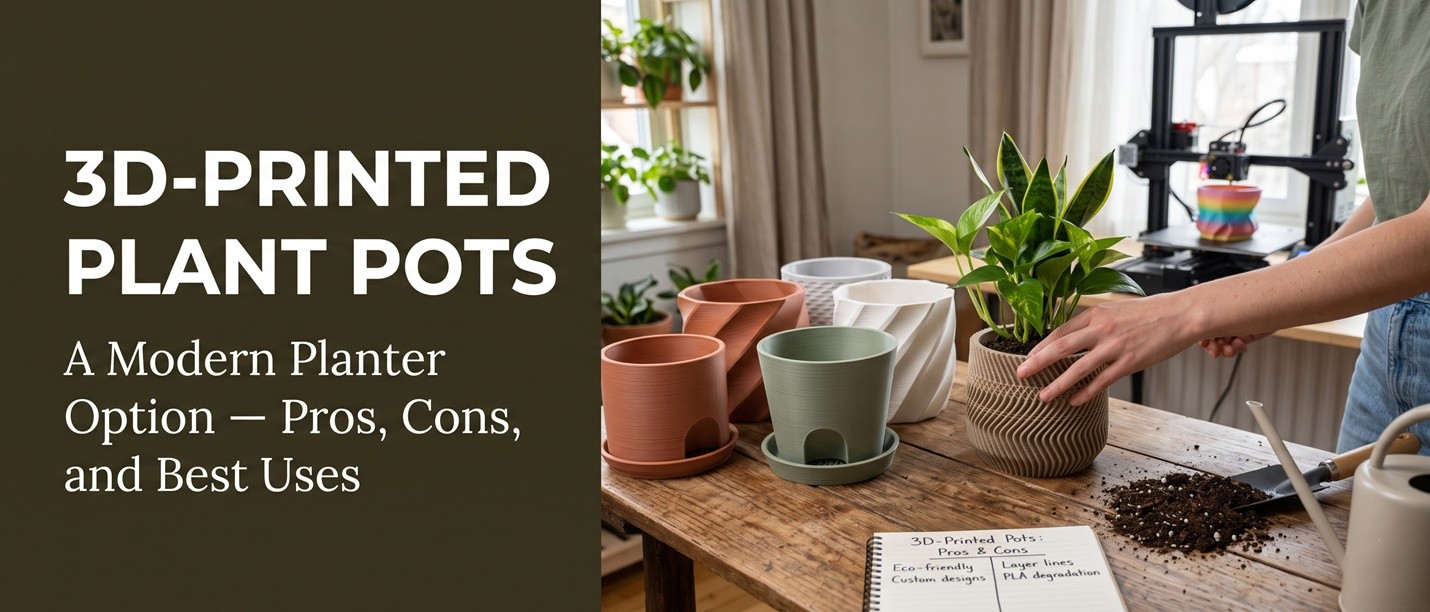
Why 3D-Printed Pots Are Worth Considering
Traditional plant pots are constrained by the manufacturing processes that make them: ceramic pots must be thrown or slip-cast in molds, plastic pots must be injection-molded (which requires expensive tooling for each new shape), and terracotta must be pressed or thrown. 3D printing removes all these constraints — a digital design can be materialized in hours, with no minimum order quantity, no tooling cost, and complete freedom of geometry. This has enabled an explosion of creative planter designs on platforms like Printables, Thingiverse, and Cults3D, ranging from minimalist cylinders to intricate parametric lattices that would be impossible to produce any other way.
For the home gardener with access to a 3D printer (or a friend with one, or a local makerspace, or a print-on-demand service like PCBWay or Shapeways), 3D-printed pots offer several practical advantages. Custom sizes can be produced to fit specific plants or shelves; integrated self-watering reservoirs and wicking systems can be designed in; modular designs allow pots to stack or interlock; and replacement parts (drip trays, water level indicators) can be reprinted as needed. The downside is that 3D printing is slow (a 20-centimeter pot takes 12 to 30 hours to print) and the materials have specific properties that affect long-term durability.
💡 Tip
If you do not own a 3D printer, most urban areas now have makerspaces or library makerspaces that offer printer access for a small fee. Alternatively, online services like PCBWay, Shapeways, and Craftcloud let you upload a design and have it printed and shipped for $15 to $60 depending on size and material. For a single decorative pot, this is often cheaper than buying a comparable ceramic pot from a specialty retailer.
Material Choice Matters More Than You Think
The most common 3D printing materials are PLA (polylactic acid, made from corn starch), PETG (glycol-modified PET, similar to water bottle plastic), ABS (acrylonitrile butadiene styrene, the plastic used in Lego), and resin (for SLA printers). Each has very different properties for plant pot use. PLA is the easiest to print and the most common, but it has a glass transition temperature of 60 degrees Celsius — meaning it will deform if left in a hot car or in direct sun on a south-facing windowsill. It is also biodegradable under industrial composting conditions, which means it will slowly degrade when buried in moist soil for years.
PETG is the best general-purpose material for plant pots. It is food-safe, watertight, flexible enough to resist cracking, has a glass transition temperature of 85 degrees Celsius (safe for outdoor use), and is resistant to moisture and most chemicals. It is the material of choice for any pot that will hold wet soil for extended periods. ABS is stronger and more heat-resistant (glass transition 105 degrees Celsius) but is harder to print and emits noxious fumes during printing. Resin pots (from SLA printers) can be extraordinarily detailed but are brittle, expensive, and most resins are not food-safe — avoid them for any pot that will contact soil or water that the plant will absorb.
⚠️ Warning
Never use PLA for outdoor pots or for pots in direct sun. PLA deforms at 60 degrees Celsius, and dark-colored PLA in direct sun can easily reach 70 degrees Celsius on a summer afternoon, causing the pot to warp and lose structural integrity. Also avoid PLA for self-watering pots where the reservoir contacts the soil — the constant moisture accelerates biodegradation. Use PETG for any pot that will see sustained moisture, sun, or heat.
Waterproofing and Drainage Considerations
FDM 3D-printed parts are not naturally watertight — the layer lines create microscopic gaps through which water can slowly seep. For most pots this is not a problem because the soil holds the water and the seepage rate is negligible, but for self-watering reservoirs or pots that will sit on a wooden surface, you need to seal the interior. The simplest method is to apply 2 to 3 coats of food-safe epoxy resin to the interior surfaces, allowing each coat to cure fully before applying the next. Alternatively, brush-on liquid rubber (like Flex Seal) or food-safe polyurethane works well. Avoid solvent-based sealers that might leach into the soil.
Drainage is critical and must be designed into the pot from the start. The simplest approach is to design the pot with drainage holes in the bottom and print a matching drip tray. Most planter designs on Printables include both. If you are designing your own, include at least one drainage hole of 8 to 12 millimeters diameter per 1,000 square centimeters of pot base area. For self-watering designs, the drainage hole is replaced by a wicking system (typically a perforated cup or column of perlite extending from the water reservoir up into the soil) and an overflow drain to prevent the reservoir from saturating the soil.
Drainage design checklist for 3D-printed pots:
- At least one drainage hole of 8-12 mm diameter
- Raised bottom (2-3 mm) so water does not pool at the base
- Matching drip tray with 5 mm raised lip to catch runoff
- If self-watering: wicking column or cup of 20-30% of pot base area
- If self-watering: overflow drain at maximum reservoir level
- If self-watering: water refill hole accessible without removing plant
Self-Watering Pot Designs
One of the most compelling applications of 3D printing for plant pots is integrated self-watering systems. Traditional self-watering pots (like the Lechuza or GroBalance systems) are injection-molded and come in a limited range of sizes and shapes. 3D-printed self-watering pots can be designed for any size plant, with optimized wicking geometry and water level indicators. The most common design is the 'sub-irrigation planter' (SIP) which has a water reservoir in the bottom of the pot, a perforated platform above the reservoir, and a wicking medium (usually perlite or potting mix) that draws water up from the reservoir into the root zone by capillary action.
Printable SIP designs are widely available on Printables and Thingiverse. Look for designs that include a fill tube (a vertical pipe from the reservoir up to the rim of the pot, allowing easy refilling with a watering can or funnel) and an overflow hole (drilled at the maximum reservoir level to prevent overfilling and root drowning). A well-designed 3D-printed SIP can hold enough water for 2 to 4 weeks between refills, depending on plant size and environmental conditions. This is especially useful for vacations, busy schedules, or plants that are sensitive to inconsistent watering (like calathea and citrus).
When 3D-Printed Pots Make Sense (and When They Do Not)
3D-printed pots shine for custom applications: an unusually shaped shelf that needs a triangular pot, a specific plant that needs a precise internal dimension, a self-watering setup for a plant that is hard to find commercial SIPs for (large monstera, fruiting citrus, deep-rooted vegetables), or a decorative cache pot in a color or finish that is not commercially available. They are also excellent for prototyping — if you are designing a new self-watering system or testing pot geometry for a research project, 3D printing allows rapid iteration at low cost.
3D-printed pots do not make sense for high-volume applications (a 3D-printed pot costs $3 to $15 in material and 10 to 30 hours of print time, while an injection-molded plastic pot costs $0.50 to $2 retail), for very large pots (a 30-centimeter diameter pot takes 40-plus hours to print and may exceed most printers' build volume), or for plants that benefit from the breathability of terracotta (succulents, cacti, Mediterranean herbs — these want porous walls that allow evaporation, which 3D-printed plastics cannot provide). For these applications, traditional materials remain superior.
💡 Tip
If you want the look of 3D-printed geometry but the breathability of terracotta, design a cache pot (decorative outer sleeve) in 3D printing and use a standard terracotta nursery pot inside. The 3D-printed exterior provides the visual appeal while the terracotta interior provides the proper growing environment. This is the best of both worlds for succulents and cacti, and it lets you swap out plants without disturbing the decorative pot.
Only logged-in users can comment
Sign in or create a free account to join the conversation — it takes less than a minute.