

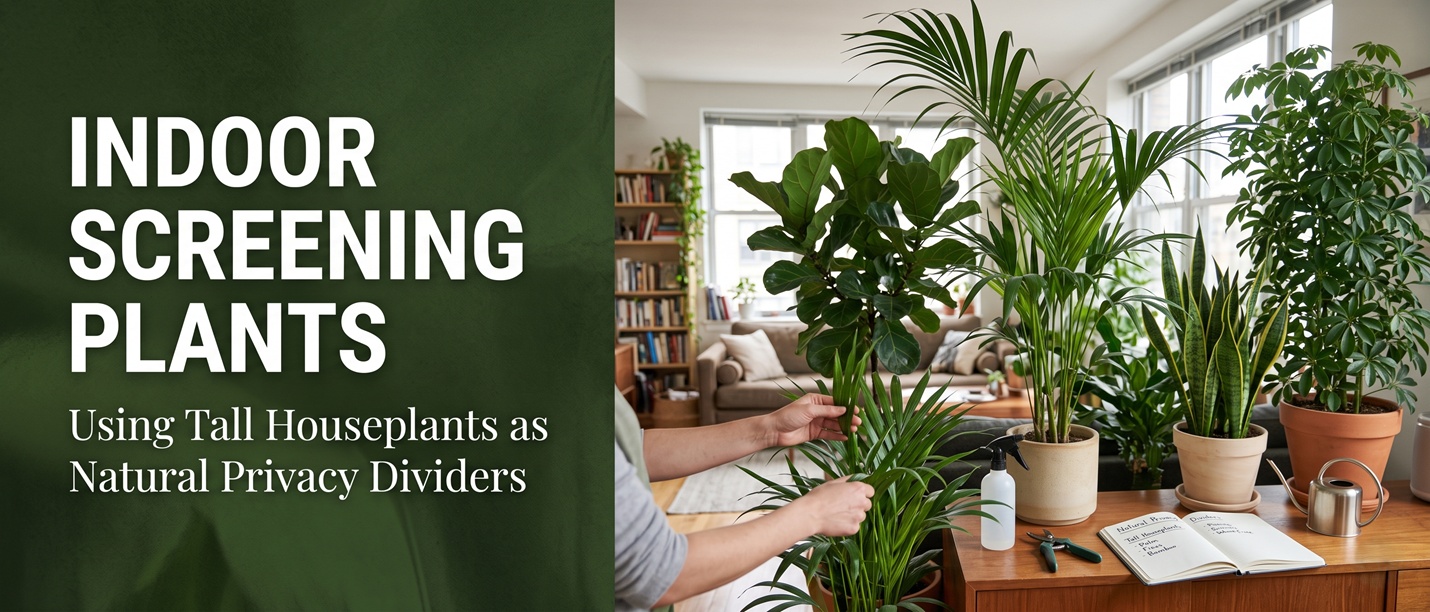
Why Plants Make Better Room Dividers Than Furniture
Open floor plans are wonderful for natural light and traffic flow, but they create a problem: where do you put a home office in a studio apartment, or a reading nook in a long living room, or a dressing area in a spacious bedroom? Traditional dividers — folding screens, bookcases, curtains — feel heavy and intrusive. Plants solve this problem elegantly. A row of tall houseplants creates a visual barrier that softens rather than blocks the space, defines a zone without enclosing it, and brings life and movement to an otherwise static arrangement.
Beyond room division, indoor screening plants serve two other purposes. They hide ugly views — a blank wall, a cluttered shelf, a neighbors window — without sacrificing light. And they add architectural presence to a room that no piece of furniture can match. A mature Ficus lyrata (fiddle leaf fig) or a 2-meter Kentia palm is a sculptural statement that anchors the room and draws the eye, becoming a focal point around which other furniture can be arranged. This guide covers the 10 best screening plants and how to use them effectively.
💡 Tip
When using plants as dividers, group them in clusters of 3-5 rather than single specimens. A cluster of medium-height plants (1.5-2 meters) creates a more effective and visually pleasing screen than a single tall plant. The cluster also looks intentional and designed, while a single tall plant can look stranded. Vary the heights within the cluster for a more natural appearance.
The 10 Best Plants for Indoor Screening
Top 10 indoor screening plants, ordered by maximum height and screening effectiveness:
- Ficus audrey (Banyan fig) — 2-3 meters, upright growth habit, large leaves, very tolerant
- Ficus lyrata (fiddle leaf fig) — 2-3 meters, dramatic fiddle-shaped leaves, demanding but stunning
- Ficus elastica (rubber plant) — 2-3 meters, glossy leaves, very tolerant, available in burgundy and variegated forms
- Strelitzia nicolai (giant bird of paradise) — 2-4 meters, banana-like leaves, dramatic tropical statement
- Howea forsteriana (Kentia palm) — 2-4 meters, arching fronds, very tolerant of low light, slow-growing
- Dypsis lutescens (areca / butterfly palm) — 2-3 meters, feathery fronds, prefers bright light, multi-stemmed
- Dracaena marginata (Madagascar dragon tree) — 2-3 meters, spiky narrow leaves on twisted stems, very tolerant
- Yucca elephantipes (spineless yucca) — 2-3 meters, architectural sword-like leaves, drought-tolerant
- Monstera deliciosa — 1.5-2.5 meters (with support), iconic split leaves, climbing or free-standing
- Schefflera amate (umbrella tree) — 2-3 meters, large glossy compound leaves, very tolerant
Selecting the Right Plant for Your Light
Light is the primary constraint when choosing a screening plant. The plant will be living in a specific spot in your home, and that spot has a specific light level that cannot be changed. Match the plant to the light, not the other way around. Bright indirect light (south or west window with sheer curtain, or directly in an east window) supports almost any plant on the list. Medium light (1-2 meters back from a bright window, or directly in a north window) limits you to Ficus elastica, Kentia palm, Dracaena marginata, and Schefflera amate. Low light (interior of a room with no direct window access) limits you to Dracaena marginata and Kentia palm, and even these will grow slowly.
Pay attention to how the light changes through the day. A spot that is bright in the morning may be dark by afternoon, and vice versa. Spend a day observing the proposed location before buying a plant. If the spot is too dark for any of the plants on the list, consider supplementing with a floor lamp fitted with a full-spectrum grow bulb — this lets you grow any plant anywhere, and the lamp doubles as ambient room lighting. Without supplemental light, no plant will thrive in a truly dark interior corner.
Staging Plants for Maximum Effect
A single tall plant standing alone in a corner often looks awkward — like a piece of forgotten furniture. The key to effective plant staging is the rule of three: combine a tall plant, a medium plant, and a trailing plant to create a layered composition that looks intentional and full. For example, a 2-meter Ficus elastica (tall element), a 1-meter peace lily (medium element), and a hanging pothos (trailing element) clustered in a corner creates a complete vignette that draws the eye and provides visual interest at three heights.
Use plant stands, plant caddies, and decorative cachepots to elevate shorter plants and unify the staging. A 30 cm plant stand elevates a 1-meter plant to 1.3 meters, putting its leaves at eye level when seated. A wheeled plant caddy under a large pot lets you move the plant for cleaning or seasonal repositioning. Decorative cachepots (the outer container that holds the plastic nursery pot) tie the plantings together visually — using the same color or material across cachepots creates a cohesive arrangement even with very different plant species.
Plant Placement as a Privacy Screen
To use plants as a privacy screen between two zones (e.g., separating a sleeping area from a living area in a studio apartment), arrange 3-5 tall plants in a loose line, spaced 30-60 cm apart. The gaps between plants allow some light and air to pass through while still creating a visual barrier. Plant choice matters — Ficus elastica with its large leaves provides near-complete screening, while Dracaena marginata with its sparse narrow leaves provides only partial screening. If you need true privacy (changing clothes, etc.), choose plants with dense foliage; if you only need visual separation, sparse plants are fine.
Place a low bench, plant stand, or shelf behind the plant screen to create a small 'room' within the larger space. Add a small table lamp and a stack of books, and you have created a defined zone that feels intentional and cozy. The plant screen defines the boundary without enclosing it — you can still see through to the rest of the room, but the visual hierarchy is clear. This is the design principle behind Japanese shoji screens and Portuguese azulejo dividers, adapted to plants.
⚠️ Warning
Avoid placing screening plants near heating or AC vents, which desiccate leaves and cause brown tipping. If a vent is unavoidable, redirect the airflow with a vent deflector ($5 from any hardware store) so the air moves parallel to the plant rather than directly at it. Even with a deflector, check the plant weekly for signs of stress and move it if leaf damage appears.
Watering and Care for Tall Plants
Tall plants in large pots have different watering needs than small houseplants. A 50 cm diameter pot holding a 2-meter Ficus can hold 30-40 liters of soil, and it may need 5-10 liters of water at a time. Use a watering can or measured container rather than a small houseplant watering bottle. Always check soil moisture 10-15 cm deep (use a moisture meter or a wooden skewer) before watering — the surface dries long before the root zone does, and overwatering large pots causes root rot that takes months to show.
Large plants also accumulate dust on their leaves, which blocks light and encourages pest problems. Wipe leaves monthly with a damp microfiber cloth, supporting each leaf from underneath with one hand while wiping with the other. For very tall plants, use a step stool — never pull leaves down to reach them, which can break the plant. Rotate the plant a quarter turn each month so all sides receive equal light, preventing the plant from leaning toward the window and developing a lopsided shape.
Long-Term Maintenance and Repotting
Tall plants eventually outgrow their pots and their spaces. Plan for the long term when choosing a screening plant — a Ficus elastica that fits your ceiling today will be too tall in 3-5 years. Choose a plant whose maximum height matches your space, leaving 30-60 cm of clearance above the plant for airflow. If a plant becomes too tall, you can prune the top (this encourages branching lower down) or move it to a larger space. Avoid buying a fast-growing plant for a small space expecting to keep it pruned — constant pruning stresses the plant and produces an unattractive shape.
Repotting large plants is a major undertaking that should be done every 3-5 years. Wait until spring, lay down plastic sheeting, water the plant thoroughly the day before, and recruit a helper — a 2-meter Ficus in a 50 cm pot can weigh 40+ kg and is impossible to lift alone. Move the plant up only one pot size, prune the root ball by one-third to encourage new fine roots, and refill with fresh well-draining potting mix. After repotting, water lightly and place the plant in a shaded spot for 2 weeks to recover. The plant will droop initially but recover within a month.

Only logged-in users can comment
Sign in or create a free account to join the conversation — it takes less than a minute.