

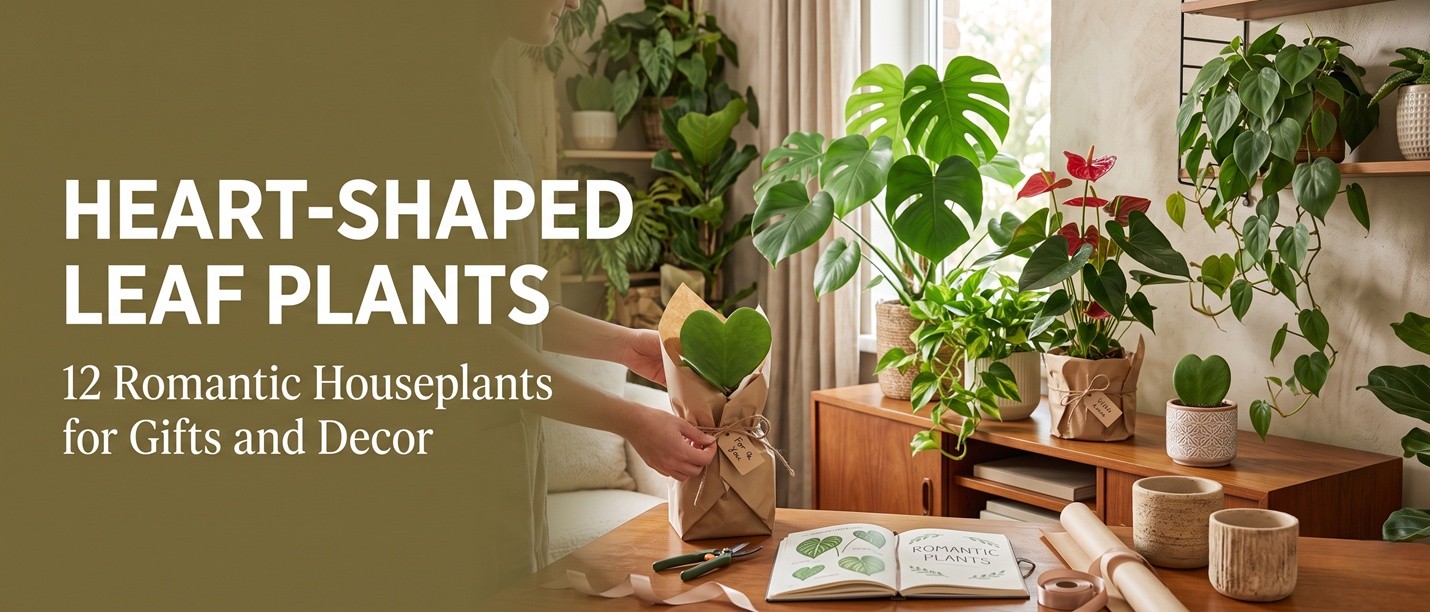
Why Heart-Shaped Leaves Matter in Plant Decor
There is something universally appealing about heart-shaped leaves. They evoke tenderness and romance without being sentimental, and they soften the architectural lines of a modern interior in a way that pointed or strap-shaped leaves cannot. Heart-shaped leaves (botanically called cordate leaves, from the Latin 'cor' for heart) appear across many unrelated plant families — Araceae (philodendrons, anthuriums), Apocynaceae (hoyas, string of hearts), Gesneriaceae (African violets, streptocarpus) — which suggests the shape is an evolutionary adaptation for maximizing light capture in shady understory habitats.
Heart-leaf plants also make excellent gifts. A Hoya kerrii single heart leaf in a small pot is a classic Valentine's Day gift that lasts for years (unlike cut flowers, which last a week). A trailing philodendron in a hanging basket makes a thoughtful housewarming present. A potted anthurium with red heart-shaped spathes brings color and life to an office desk. This guide covers 12 of the most desirable heart-leaf houseplants, ranging from impossible-to-kill to collector-specimen, so you can choose the right one for any situation.
💡 Tip
If you want a single plant that combines heart-shaped leaves, easy care, and a romantic story, choose Hoya kerrii. The plant is literally sold as a single heart-shaped leaf in a small pot — perfect for gifting — and with proper care it will grow into a trailing vine covered in hearts over several years. Even the slow growth is part of the charm: a Hoya kerrii is a relationship plant, not an impulse purchase.
The 12 Best Heart-Shaped Houseplants
These 12 species span the full range of houseplant care difficulty, from impossible-to-kill to challenging collector plants. Each has heart-shaped leaves (or heart-shaped bracts, in the case of anthurium) and would make a worthy addition to a heart-leaf collection. Care notes are brief — for detailed care of any specific plant, see the plant's individual monograph in our blog archive.
12 heart-shaped leaf houseplants, ordered roughly by ease of care:
- Philodendron hederaceum (heart-leaf philodendron) — classic trailing vine, deep green heart leaves, impossible to kill, tolerates low light
- Philodendron micans — velvet-leaf version of heart-leaf philodendron, deep green leaves with purple undersides, slightly more demanding
- Philodendron gloriosum — crawling philodendron with massive heart leaves and prominent white veins, collector plant
- Syngonium podophyllum (arrowhead plant) — heart-shaped leaves when young (becoming arrow-shaped at maturity), very easy
- Anthurium andraeanum (flamingo flower) — heart-shaped red/pink/white spathes (modified leaves) year-round, moderate care
- Anthurium clarinervium — velvet heart leaves with white veins, more demanding than flamingo flower, beautiful
- Hoya kerrii (sweetheart plant) — single thick heart-shaped leaf, slow-growing vine, classic Valentine's gift
- Ceropegia woodii (string of hearts) — trailing chain of tiny heart-shaped leaves, prefers neglect, ideal for hanging baskets
- Cyclamen persicum — heart-shaped leaves with silver patterning, winter-blooming with reflexed pink/white flowers, goes dormant in summer
- Caladium — tropical tuber plant with paper-thin heart leaves in combinations of red, pink, white, and green, dormant in winter
- Begonia maculata (polka dot begonia) — heart-shaped olive leaves with silver polka dots and red undersides, moderately demanding
- Stephanotis floribunda (Madagascar jasmine) — heart-shaped leaves on a climbing vine with intensely fragrant white flowers
Easy Heart-Leaf Plants for Beginners
The Philodendron hederaceum (heart-leaf philodendron) is the gateway plant for heart-leaf enthusiasts. It is among the most tolerant houseplants in existence, surviving low light, irregular watering, and benign neglect for years. The trailing vines can reach 3-4 meters, making it ideal for hanging baskets or shelves where the heart-shaped leaves can cascade. New growth emerges a bright chartreuse green, darkening to deep emerald with age. The plant is propagated easily from stem cuttings in water, so one plant can populate an entire room within a year.
Syngonium podophyllum (arrowhead plant) is the second easy-care heart-leaf. Its leaves start heart-shaped and become arrow-shaped as the plant matures, giving it a unique appearance that changes over time. The plant tolerates low light but develops more vibrant variegation in brighter conditions. Cultivars include 'White Butterfly' (cream and green marbled leaves), 'Pink Allusion' (pink-tinted leaves), and 'Neon' (bright pink new growth). Syngonium is also an excellent air plant, with NASA studies showing it removes formaldehyde and other indoor pollutants from the air.
Statement Heart-Leaf Plants for Bright Spaces
Anthurium andraeanum (flamingo flower) brings bold color to the heart-leaf collection. The 'flowers' are actually modified leaves called spathes — glossy, heart-shaped, and available in shades of red, pink, white, coral, and even purple. With proper care, the plant produces new spathes year-round, each lasting 6-8 weeks on the plant. Anthurium needs bright indirect light, high humidity, and consistent moisture to bloom well. The plant is mildly toxic to pets and humans, so keep it out of reach of curious cats and small children.
Caladiums are the show-stopping summer heart-leaf plants. Grown from tubers planted in spring, they produce masses of paper-thin heart-shaped leaves in combinations of red, pink, white, and green that look almost painted. Caladiums are tropical plants that thrive in warm, humid conditions and go completely dormant in winter — the leaves die back and the tuber rests underground. The tubers can be stored dry through winter and replanted each spring, making caladiums a renewable annual for warm rooms or shaded patios.
Trailing Heart-Leaf Plants for Hanging Baskets
Ceropegia woodii (string of hearts) is one of the most charming trailing houseplants. Its long cascading stems carry dozens of tiny heart-shaped leaves patterned in silver and green on top and pinkish-purple underneath. The plant looks delicate but is surprisingly tough — it stores water in its tuberous roots and prefers to be ignored rather than fussed over. Water only when the soil is completely dry and the leaves feel slightly soft. Provide bright indirect light for best coloration, and the plant will produce small lantern-shaped pink flowers intermittently through the year.
Hoya kerrii (sweetheart plant) is the iconic heart-leaf plant. In its mature form, it is a climbing vine with pairs of thick fleshy heart-shaped leaves spaced along the stem. More commonly, it is sold as a single rooted heart leaf in a small pot, marketed as a Valentine's Day gift. These single-leaf plants are slow growers — a single leaf can take 2-3 years to produce a vine. Give Hoya kerrii very bright indirect light, water only when the soil is completely dry, and be patient. The plant rewards patience with decades of growth and, eventually, clusters of star-shaped flowers.
⚠️ Warning
Single-leaf Hoya kerrii plants sold as Valentine's gifts rarely grow into full vines because they lack a node (the growth point where new stems emerge). A single leaf with no node will root and live for years as a single leaf, but it will not vine. If you want a vining Hoya kerrii, buy a plant with a visible stem and multiple leaves rather than a single leaf cutting. This is the most common disappointment with Hoya kerrii gifts.
Heart-Leaf Plants for Advanced Collectors
Philodendron gloriosum is the collector's heart-leaf plant. It is a crawling philodendron (rather than climbing), with massive velvety heart-shaped leaves that can reach 60 cm across. The leaves are deep green with prominent pale green or white veins and pink petioles, creating a striking architectural specimen. P. gloriosum requires consistently warm temperatures (20-28°C), high humidity (60 percent or more), and a well-draining aroid mix. The rhizome should be partially exposed on the soil surface, with only the roots buried.
Anthurium clarinervium is the velvet-leaf counterpart to the common flamingo flower. Its heart-shaped leaves are dark olive green with a velvety sheen and prominent white veining that looks almost embroidered. The plant is more demanding than A. andraeanum — it needs higher humidity, more consistent moisture, and brighter but indirect light — but the foliage is unmatched for beauty. Mature plants produce subtle pale green spathes that are less showy than the common anthurium but still attractive. A. clarinervium is a true collector's plant that commands attention even when not blooming.
Displaying Heart-Leaf Plants
Heart-shaped leaves are visually soft and work well in clusters. Group three or four heart-leaf plants of different sizes and textures on a plant shelf — a trailing philodendron, an upright anthurium, and a compact Hoya kerrii — to create a 'romantic corner' that draws the eye. Use pots in soft colors (cream, dusty pink, sage green, terracotta) rather than stark white or black, which can feel clinical against the soft leaf shapes. Heart-leaf plants also pair beautifully with vintage or handcrafted containers — ceramic pots, woven baskets, or concrete planters.
For gifting, the single-leaf Hoya kerrii remains the gold standard — a single heart in a small pot is unambiguously romantic without being cliché. Pair it with a handwritten note explaining that the plant will grow with the relationship, and you have a meaningful gift that lasts far longer than cut flowers. For housewarmings, a potted heart-leaf philodendron is more universally appropriate and easier for the recipient to keep alive. Avoid giving caladiums or cyclamen as gifts unless you know the recipient is an experienced plant owner — these have dormancy requirements that confuse beginners.
💡 Tip
Heart-leaf plants make excellent office plants because their soft shape works in any decor style, from corporate minimalist to bohemian eclectic. A single heart-leaf philodendron on a filing cabinet, with its vines cascading down the side, brings life to even the most sterile cubicle without demanding much attention from the plant owner.
Only logged-in users can comment
Sign in or create a free account to join the conversation — it takes less than a minute.