

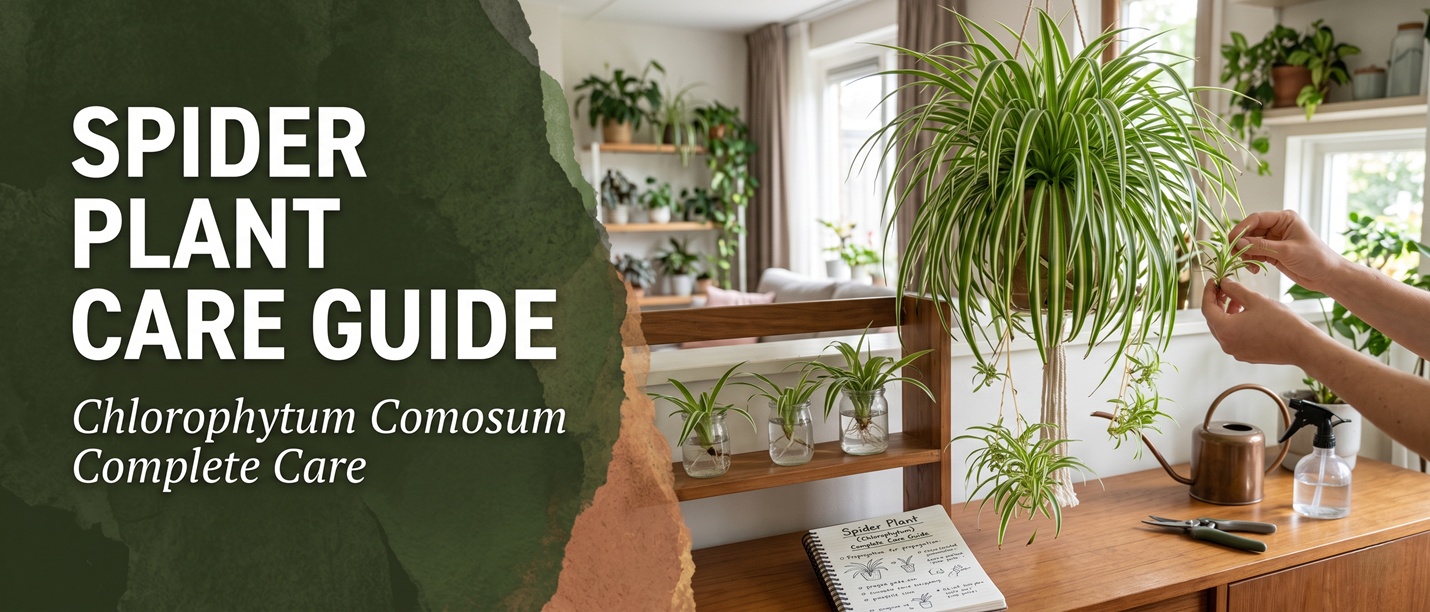
Why Spider Plants Have Been Popular for 200 Years
Spider plants (Chlorophytum comosum) have been grown as houseplants since the Victorian era, and for good reason. They are nearly indestructible, they tolerate a wide range of light and water conditions, they produce cascading runners of baby plantlets that are easy to share, and they were flagged by NASA's Clean Air Study as effective at removing indoor pollutants. They are the plant most often recommended to first-time plant owners, and they are one of the few species that genuinely lives up to the 'impossible to kill' label.
Native to southern and western Africa, spider plants grow as understory plants in forest edges and grasslands. This origin explains their adaptability: they evolved to handle both the dappled shade of forest margins and the brighter light of open grassland, which is why they thrive in everything from a dim office to a bright kitchen window. Understanding where they come from also explains their water preferences — they get regular rainfall in their native habitat but grow in well-drained soil, so they like evenly moist conditions without sitting in water.
💡 Tip
If you have never grown a spider plant, start with the classic Chlorophytum comosum 'Vittatum' — the variety with a white stripe down the center of each leaf. It is the most forgiving and the most attractive of the common forms. Once you have one established, you will have baby plantlets to give away within months.
Light: Where Spider Plants Actually Thrive
Spider plants prefer bright indirect light but tolerate a much wider range. A north- or east-facing window is ideal, a south- or west-facing window with a sheer curtain works well, and they will even grow (slowly) in office fluorescent light. The one location they dislike is direct hot sun, which scorches the leaves and bleaches out the variegation. If your spider plant has washed-out or brown-tipped leaves, light is the first thing to check.
Variegated varieties (Vittatum, Variegatum) need slightly more light than the solid-green form to maintain their stripes. In too-dim conditions, the variegation fades and the plant slowly reverts to solid green — a survival strategy, since green leaves photosynthesize more efficiently in low light. If you want to keep the stripes, give the plant at least 200-300 lux of bright indirect light for 8+ hours a day.
Watering: The Right Cadence for Chlorophytum
Spider plants like evenly moist soil but will not tolerate sitting in water. The watering cadence depends on light and temperature: in bright warm conditions, water when the top 2 cm of soil is dry (typically every 5-7 days); in dim or cool conditions, let the soil dry to 3-4 cm deep (every 10-14 days). The plant will tell you when it is thirsty — the leaves lose their rigid arch and droop noticeably, then recover fully within hours of watering. This dramatic wilt-and-recover cycle is one of the reasons spider plants are so beginner-friendly.
One quirk of spider plants: their thick tuberous roots store water and can rot easily if the soil stays wet. Always use a pot with drainage holes, and empty the saucer 30 minutes after watering. A spider plant in a pot without drainage is on a slow path to root rot. Repotting every 2-3 years into fresh soil also helps, because the tuberous roots eventually fill the pot and reduce drainage.
⚠️ Warning
Spider plants are sensitive to fluoride and chlorine in tap water, which causes the brown leaf tips that the species is famous for. If your tap water is heavily fluoridated, let it sit in an open container overnight (chlorine dissipates, fluoride does not but the plant tolerates it better at room temperature), or use filtered water. Rainwater or distilled water eliminates the problem entirely.
Soil and Potting
Spider plants are not picky about soil. Any general-purpose potting mix works, ideally one with some perlite or orchid bark added for drainage. A roughly 70/30 mix of standard potting soil to perlite is a good starting point. Avoid heavy garden soil or cheap potting soil that compacts into a brick when dry — both suffocate the tuberous roots.
When potting or repotting, choose a container only slightly larger than the root ball. Spider plants actually prefer being slightly root-bound and produce more plantlets when they are. A pot that is too large holds too much soil moisture and encourages root rot. The white tuberous roots are obvious when you take the plant out of its pot — they look like small swollen cylinders and are completely normal, not a sign of pests or disease.
Propagation: The Easiest Plant to Share
Spider plants are arguably the easiest houseplant to propagate, thanks to their habit of producing baby plantlets on long trailing runners. Mature plants send out 30-60 cm stems (called stolons) from the center, each tipped with a miniature spider plant. These plantlets already have tiny roots forming at their base, and they will grow into full plants with very little help.
Two propagation methods:
- Soil method: Fill a small pot with moist potting soil. Pin the plantlet to the soil surface with a bent paperclip or hairpin, leaving it attached to the mother plant. Water lightly and keep in bright indirect light. After 3-4 weeks the plantlet will have rooted into the soil; cut the stolon connecting it to the mother plant.
- Water method: Pinch off a plantlet and place it in a small jar of water so just the base is submerged. Change the water weekly. Roots will grow within 7-10 days; pot into soil once roots are 3-5 cm long.
💡 Tip
For the highest success rate, propagate in spring or summer when the plant is actively growing. Plantlets produced in fall or winter root more slowly. Each mature spider plant can produce 10-20 plantlets per year, so you will have plenty of gifts for friends and coworkers.
Varieties: Beyond the Basic Spider Plant
The standard spider plant seen in most homes is Chlorophytum comosum 'Vittatum', with a creamy white stripe down the center of each leaf. Equally common is 'Variegatum', which has green centers with white edges — the opposite pattern. Both are equally easy to grow, and the choice is purely aesthetic.
Less common but worth seeking out is the 'Bonnie' cultivar, which has curly, twisted leaves that give the plant a more architectural look. There is also a solid-green form (Chlorophytum comosum without any cultivar name) that some growers prefer for its stronger constitution and faster growth. The Hawaiian spider plant (Chlorophytum viridescens) is a related species with wider, more lush leaves and a slightly more tropical look.
Common Problems and Their Fixes
Brown leaf tips are the #1 spider plant complaint, and they are almost always caused by fluoride or chlorine in tap water, low humidity, or underwatering. The damaged tips do not recover, but you can trim them with scissors for a cleaner look. Switching to filtered or rainwater and raising humidity usually stops new tips from browning.
Pale, washed-out leaves usually mean too much direct sun. Move the plant to bright indirect light and the variegation will return on new growth. Soft, mushy leaves and a foul smell from the soil indicate root rot from overwatering — repot immediately into fresh dry soil, trim off any black roots, and water less frequently going forward.
⚠️ Warning
Spider plants are listed as non-toxic to cats and dogs by the ASPCA, which is one of their biggest advantages for pet owners. However, cats in particular love to chew on the arching leaves, and a determined cat can shred a spider plant within hours. If you have cats, hang the plant from the ceiling or place it on a high shelf out of reach.
A Note on Spider Plants and Air Purification
The 1989 NASA Clean Air Study found that spider plants were effective at removing formaldehyde, xylene, and toluene from sealed test chambers. This finding launched a wave of 'air purifying plants' marketing that has persisted for 30 years. The reality is more modest: in a normal home or office with normal ventilation, you would need 10-20 spider plants per square meter to match the air-cleaning effect of simply opening a window for 10 minutes. Spider plants do remove some indoor pollutants, but the effect is small. Grow them because you like them, not because they will clean your air.
Only logged-in users can comment
Sign in or create a free account to join the conversation — it takes less than a minute.