

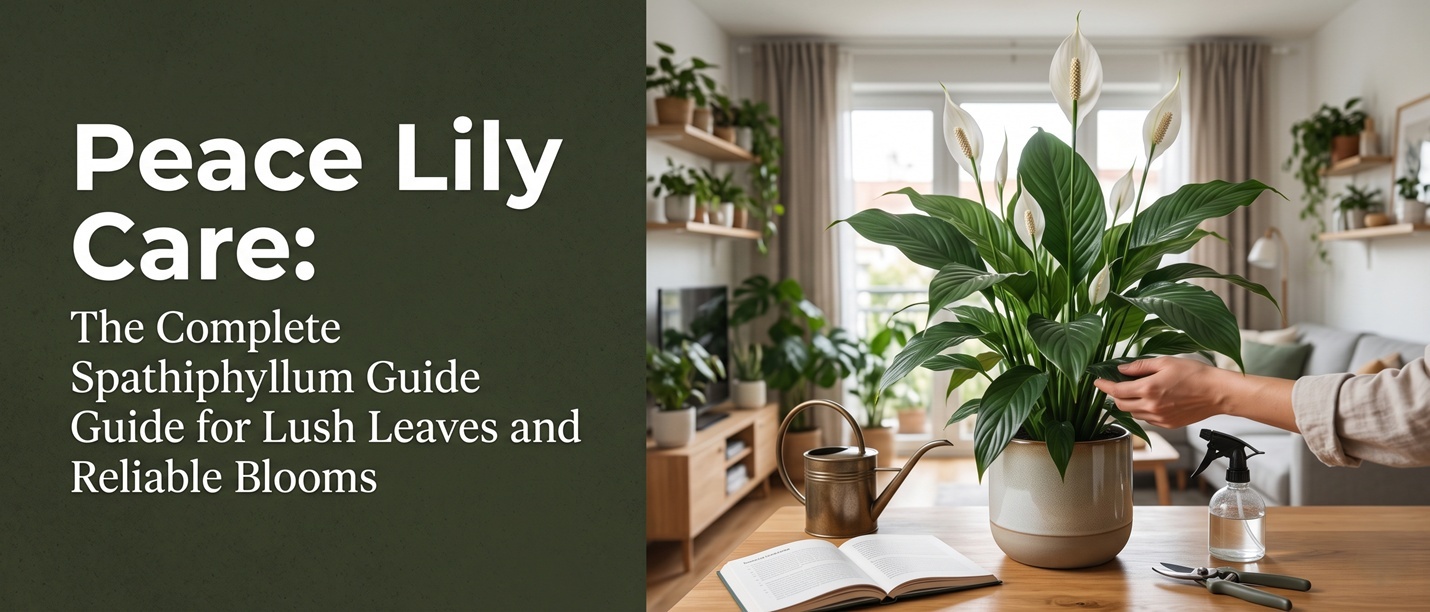
Why the Peace Lily Is a Classic
Spathiphyllum, the peace lily, has been a fixture of homes and offices for nearly a century, and for good reason. It tolerates low light, tells you clearly when it needs water, removes a wide range of indoor air pollutants (as documented in the famous NASA Clean Air Study), and produces elegant white spathes that give it a more refined look than most foliage houseplants. A well-grown peace lily can live for 20+ years and eventually fill a 50 cm pot with a dense clump of dark green leaves.
Despite the common name, the peace lily is not a true lily and is not closely related to Lilium species. It is a member of the Araceae family, related to Philodendron, Monstera, and Anthurium. The white 'flower' is actually a modified leaf called a spathe that surrounds a club-shaped spadix covered in tiny true flowers. Indoors, mature plants bloom primarily in spring and summer, though cultivars like 'Domino' and 'Sensation' can produce spathes year-round in good conditions.
💡 Tip
The peace lily is one of the few houseplants that gives a clear visible signal when it needs water — the leaves droop dramatically within 24 hours of the soil going dry. Once you learn to read the signal, you will never overwater or underwater this plant again.
Light: Bright Indirect for Blooms, Low Light for Survival
Peace lilies survive in low light but only bloom in brighter conditions. A north-facing window or a corner 2–3 meters from a window will keep the plant alive and green, but spathes will be rare. For regular flowering, place the plant in bright indirect light: an east window where it receives morning sun, or near a west or south window with a sheer curtain filtering the strongest rays.
Direct midday or afternoon sun scorches the leaves within hours, producing pale brown patches that do not recover. If your plant is in too-bright light, the leaves may also develop a bleached, yellow-green appearance. Move it gradually to a shadier spot and the new growth will return to deep green within a few weeks.
Watering and the Famous Droop
The peace lily's droop-response is both a feature and a bug. On the plus side, you cannot accidentally overwater by following the plant's lead — water when the leaves first start to droop and the top 2–3 cm of soil feels dry. On the minus side, repeated episodes of severe drooping stress the plant and shorten its lifespan. Aim to water just before the droop begins, when the soil is dry to a finger-depth but the leaves are still perky.
Water thoroughly until liquid runs from the drainage holes, then empty the saucer after 15 minutes. Peace lilies are sensitive to chlorine and fluoride in tap water, which causes brown leaf tips. Use filtered water, rainwater, or tap water that has been left in an open jug for 24 hours to allow chlorine to dissipate. Consistent watering with room-temperature water also prevents the cold-shock that can cause leaves to develop translucent patches.
⚠️ Warning
If your peace lily has persistent brown tips despite good watering, the cause is usually fluoride or hard water minerals. Switch to filtered or rainwater for two months and trim the brown tips with sterile scissors. The new growth should come in clean.
Humidity: The Hidden Variable
Peace lilies evolved in tropical rainforest understories where humidity rarely drops below 60%. Typical home humidity of 30–40% is at the low end of what they tolerate. Brown leaf tips and edges are the classic sign of low humidity, distinct from the more extreme brown caused by fluoride in water.
Increase humidity with a pebble tray filled with water under the pot (the pot must sit above the water level, not in it), a small humidifier placed nearby, or by grouping the peace lily with other plants. Misting is briefly satisfying but does almost nothing for humidity — the water evaporates in seconds. Aim for at least 50% relative humidity around the plant for best results.
Soil, Fertilizer, and Repotting
Use a well-draining but moisture-retentive mix — equal parts peat-free potting soil, perlite, and coco coir is ideal. The plant likes its roots crowded, so do not rush to repot. Move up only one pot size (2–3 cm wider) every 2–3 years, when roots are visibly circling the surface or growing from drainage holes. Spring is the best time to repot.
Feed monthly from spring through early autumn with a balanced houseplant fertilizer at half strength. A fertilizer slightly higher in phosphorus (the middle number, e.g. 10-30-10) encourages blooming — apply once in early spring to support spathe formation. Stop feeding entirely in winter when growth slows.
Encouraging Blooms
If your peace lily has stopped blooming, the most common cause is insufficient light. Move it gradually to a brighter location. The second most common cause is the plant being rootbound in a pot that is far too small — even though peace lilies like crowding, an extremely pot-bound plant diverts all energy to root growth and stops blooming. Repot into a slightly larger container with fresh soil.
Plants also need a slight cool-down period in winter to initiate flower buds. Aim for nighttime temperatures around 16–18°C for 6–8 weeks in winter, with normal daytime temperatures of 20–24°C. Avoid placing the plant near heat vents or radiators, which keep the temperature too constant and dry the air.
💡 Tip
After a spathe fades from white to green to brown, cut the flower stalk off at the base. This redirects the plant's energy into new growth and the next round of blooms rather than seed production.
Propagation by Division
Peace lilies are propagated by division rather than cuttings, and the process is straightforward. At repotting time, gently shake off the soil from the root ball and look for natural divisions where clusters of leaves emerge from separate crown points. Use a sharp sterile knife to cut between crowns, ensuring each division has at least 3–5 leaves and a healthy root system.
Pot each division in fresh soil at the same depth it was growing before, water thoroughly, and place in a warm shaded spot for two weeks while it recovers. New growth should appear in 4–6 weeks. The best time to divide is late spring, when the plant is in active growth and can recover quickly.
Toxicity
Like all aroids, peace lilies contain insoluble calcium oxalate crystals. Chewing the leaves causes immediate burning, swelling of the mouth and throat, drooling, and vomiting in pets. Symptoms are usually self-limiting — pets learn to avoid the plant after one bad experience — but contact a veterinarian if symptoms are severe or persistent. Keep peace lilies out of reach of curious cats and small children.

Only logged-in users can comment
Sign in or create a free account to join the conversation — it takes less than a minute.