

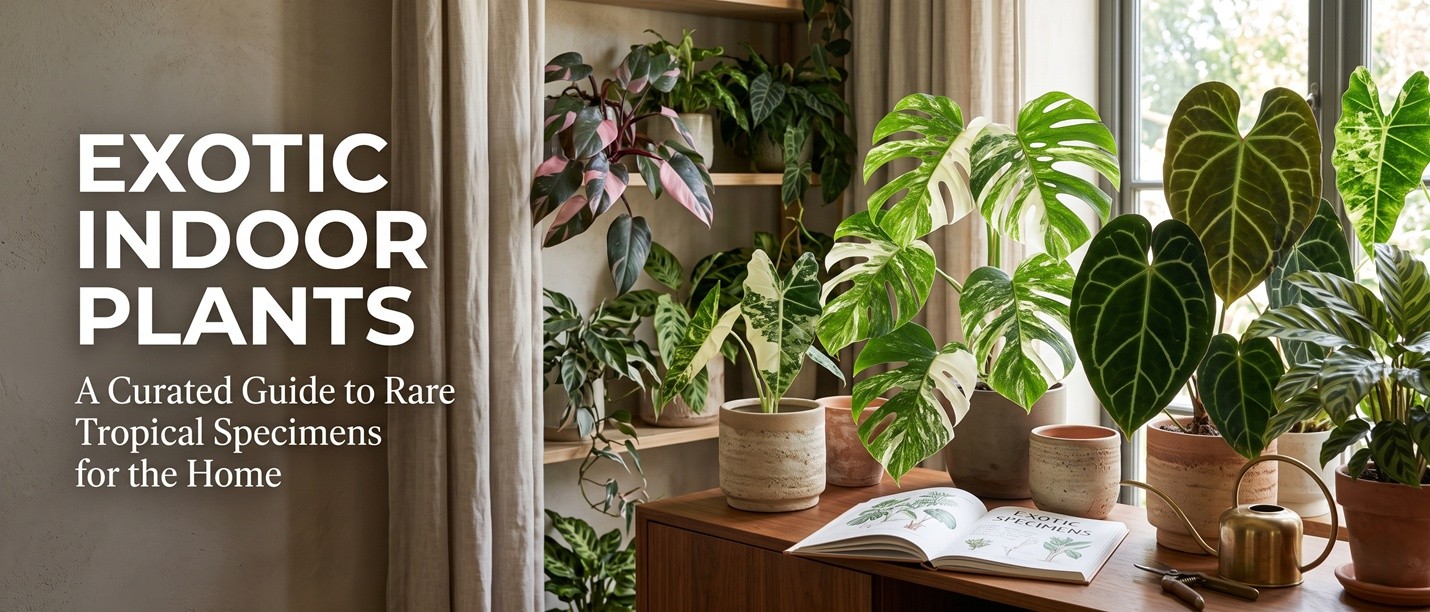
Why Collectors Pursue Rare Plants
The houseplant hobby has experienced a renaissance in the last decade, and a significant part of the appeal for serious collectors is the pursuit of unusual species and cultivars that are not available at the local garden center. These plants often come from specific ecological niches in tropical rainforests — the deep understory of Borneo, the cloud forests of Ecuador, the limestone karsts of Vietnam — and have evolved extraordinary leaf shapes, colors, and patterns to survive in those environments. Bringing them into a home environment is both a horticultural challenge and a way to surround yourself with living art.
The collector market is driven by variegation (white, cream, or yellow patches on leaves caused by genetic chimeras), unusual leaf shapes (fenestrations, perforations, peltate forms), and improbable colors (iridescent blues, metallic silvers, deep burgundies). Prices for the rarest specimens have reached thousands of dollars for a single cutting, though most desirable exotic plants can be acquired for $20 to $100 once they enter commercial tissue culture. The most rewarding approach for new collectors is to start with moderately priced exotics that are reliably available, learn their care, and gradually expand into rarer specimens.
💡 Tip
Join a local plant swap or online plant community before buying rare plants from specialty shops. Collectors frequently trade cuttings and divisions at a fraction of retail prices, and you will learn more about each species' quirks from someone who has actually grown it than from any care guide. Facebook groups, Reddit's r/PlantSwap, and Instagram plant communities are all active channels for finding rare specimens.
Philodendron Gloriosum: The Velvety Crawler
Philodendron gloriosum is a crawling philodendron from the rainforests of Colombia, distinguished by enormous heart-shaped leaves with a deep velvet surface, prominent white veining, and a pale green or pinkish margin. Unlike climbing philodendrons, gloriosum creeps horizontally along the soil surface, sending roots down from a rhizome that crawls forward. Each new leaf unfurls dramatically over 2 to 3 weeks and can reach 60 centimeters or more across on a mature plant. The velvety texture of the leaf surface is caused by tiny microscopic hairs that scatter light, giving the leaf an almost black-green appearance in low light and a luminous emerald glow in bright light.
Care requirements are specific but not difficult once understood. Gloriosum wants bright indirect light (a north or east window is ideal), humidity of 60 to 80 percent, and a loose, airy mix (orchid bark, perlite, coco coir, and charcoal in equal parts). The rhizome must never be buried — it should sit horizontally on top of the soil with roots going down. Water when the top 3 to 5 centimeters are dry; do not let the soil stay soggy or the rhizome will rot. Provide a long shallow pot rather than a deep one to accommodate the crawling growth habit. A mature gloriosum is a statement plant unlike anything else in the houseplant world.
Monstera Adansonii Variegata: The Holy Grail
Monstera adansonii variegata is the variegated form of the popular Swiss cheese vine, with leaves that combine green tissue with pure white or cream patches. The variegation is unstable — it can revert to solid green if light is too low, or go 'fully white' (which is fatal since white tissue cannot photosynthesize) if light is too high. Each leaf is a gamble: some come out mostly green with a white splash, others are 80 percent white with green speckles, and the most desirable have large distinct sectors of each color. Prices for established plants reached $1,000-plus during the pandemic houseplant boom and have since settled into the $100 to $400 range for rooted cuttings.
Care is the same as for standard Monstera adansonii but with two critical adjustments. First, light must be bright indirect — too little light and the plant reverts to green (lose the variegation), too much direct sun and the white patches burn irreversibly. A spot near an east-facing window with morning sun is ideal. Second, the plant needs to be pruned regularly to remove any fully green growth that emerges from below a node — this is 'reversion' and will take over the plant if not removed. Cut green stems back to a node with variegated growth above it. Propagate the variegated cuttings to multiply your collection or trade with other collectors.
⚠️ Warning
Variegated Monsteras and Philodendrons cannot tolerate low light. The white portions of the leaves have no chlorophyll and cannot produce energy; the green portions must work twice as hard to compensate. If light is insufficient, the plant will produce smaller, weaker leaves and eventually decline. If you cannot provide bright indirect light (2,000+ lux for 12+ hours per day), do not invest in variegated plants — they will disappoint you.
Alocasia Frydek: The Green Velvet Elephant Ear
Alocasia Frydek (properly Alocasia micholitziana 'Frydek') is a striking elephant ear with deep green velvet leaves, pronounced white veining, and a burgundy reverse. The leaves are arrowhead-shaped and held upright on tall stems, giving the plant a sculptural architectural presence. Native to the Philippines, Frydek grows from a tuber and can reach 60 to 90 centimeters tall indoors. The velvety leaf surface and high-contrast white veining make it one of the most photogenic plants in the aroid world.
Care is moderate to difficult. Frydek wants bright indirect light (it tolerates lower light but grows slowly and loses leaf size), high humidity (60 percent or higher — essential for velvet-leaf alocasias, which develop crispy brown edges in dry air), and a chunky, well-draining aroid mix (orchid bark, perlite, coco coir). Water when the top 3 to 5 centimeters of soil are dry; the tuber rots easily if kept too wet. Frydek is prone to spider mites — inspect the undersides of leaves weekly and treat preventively with neem oil. In winter, the plant may go dormant and drop all its leaves; do not throw it away — keep the tuber barely moist and resume normal watering in spring.
Anthurium Clarinervium: The Velvet Bird's Nest
Anthurium clarinervium is a bird's nest anthurium from the limestone hills of Mexico, with heart-shaped leaves up to 30 centimeters across, deep velvety green surface, and dramatic white veining that looks almost painted on. The leaves are held on short stems emerging from a central rosette, creating a compact, sculptural plant that fits well on a side table or shelf. Unlike many anthuriums which are grown for their flowers, clarinervium is grown purely for its extraordinary foliage.
Care requirements are similar to Alocasia Frydek but slightly more forgiving. Bright indirect light, 50 to 70 percent humidity, and a very chunky mix (50 percent orchid bark, 30 percent perlite, 20 percent coco coir) — clarinervium is an epiphyte in the wild and needs the roots to breathe. Water when the top 5 centimeters of soil are dry; the plant is more tolerant of underwatering than overwatering. Anthuriums appreciate warmth — keep above 18 degrees Celsius and avoid cold drafts. Feed monthly in spring and summer with a diluted balanced fertilizer. Mature plants produce elegant spathes (the classic anthurium flower) in muted green-yellow.
Begonia Maculata: The Polka Dot Begonia
Begonia maculata (also called the polka dot begonia or Wightii) is a cane-stemmed begonia with olive green leaves covered in silvery-white polka dots, with a deep burgundy underside. The leaves are asymmetric and pointed, giving the plant a distinctive appearance. Mature plants produce cascading clusters of small white flowers with yellow centers in spring and summer. Native to the rainforests of Brazil, maculata has become one of the most fashionable houseplants of the past five years due to its striking appearance and surprisingly easy care.
Care is moderate. Bright indirect light (too much direct sun burns the leaves; too little light reduces the polka dot contrast). Humidity of 50 to 70 percent — maculata develops crispy leaf edges in dry air but tolerates average household humidity better than many begonias. Water when the top 2 to 3 centimeters of soil are dry; begonias are sensitive to overwatering and root rot. Use a light, well-draining mix with added perlite. Pinch the growing tips regularly to keep the plant bushy — cane begonias tend to grow tall and leggy without pruning. Propagate easily from stem cuttings in water or directly in soil.
💡 Tip
Begonia maculata is one of the easiest exotic-looking plants to propagate and share. Take a stem cutting with at least two nodes, remove the bottom leaves, and place in water. Roots emerge in 2 to 3 weeks. Once roots are 3 to 5 centimeters long, pot in light potting mix. A single mature plant can produce dozens of cuttings per year, making maculata an excellent 'gift plant' for sharing with friends and trading for other species.
Building a Humid Environment for Exotics
The single biggest barrier to growing exotic tropical plants indoors is humidity. Most homes have 30 to 50 percent relative humidity, while tropical understory plants want 60 to 80 percent. Without supplemental humidity, exotics develop crispy leaf edges, slow growth, and increased pest susceptibility. The most effective solution for a serious collection is a humidity cabinet or greenhouse cabinet — an IKEA Detolf or similar glass-front cabinet converted into a plant display case, with a small humidifier and a fan inside to circulate air. These cabinets maintain 70 to 90 percent humidity and create a microclimate that allows even the most demanding species to thrive.
For a smaller scale, group plants together (plants transpire moisture, raising local humidity), place pots on trays of pebbles filled with water (the water evaporates around the plants), or run a room humidifier near the collection. Misting with a spray bottle is largely ineffective — the water evaporates in minutes and does not meaningfully raise humidity — but it does help dislodge dust. For a single statement plant, a glass cloche or terrarium provides near-100 percent humidity, though this only works for plants that tolerate the confined environment (ferns, fittonia, small begonias).

Only logged-in users can comment
Sign in or create a free account to join the conversation — it takes less than a minute.