

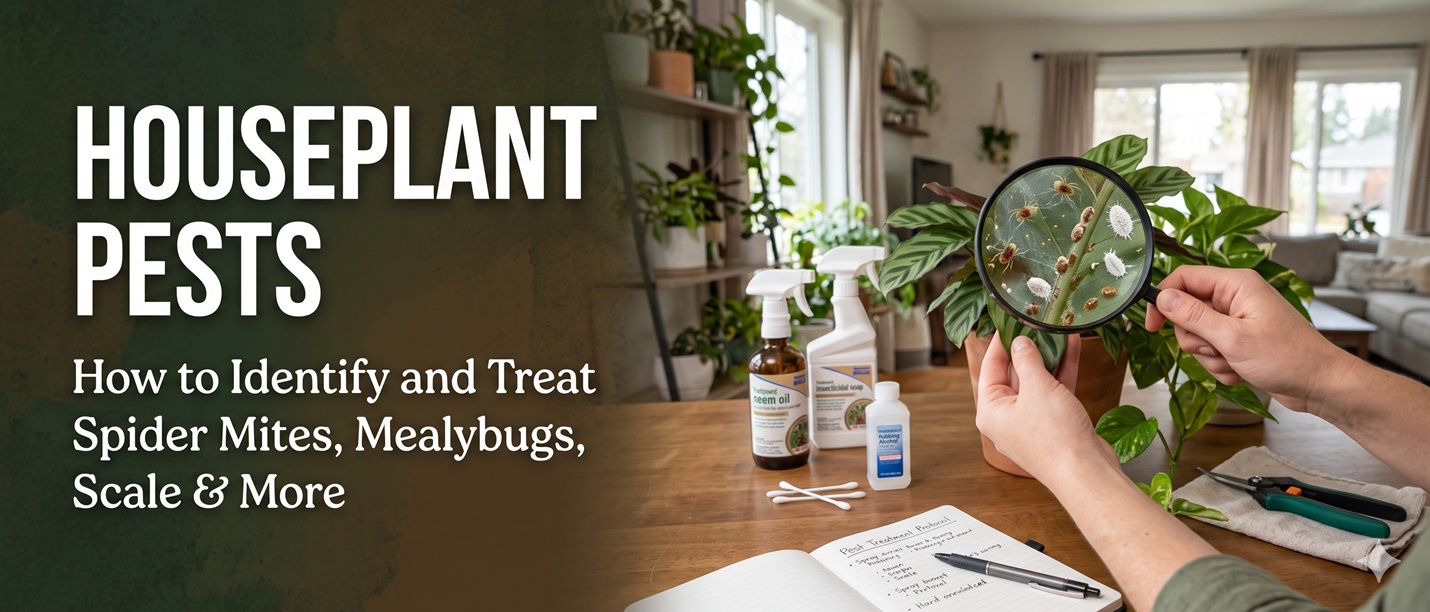
Why Houseplant Pests Are a Year-Round Problem
Indoor plants live in a stable, climate-controlled environment that is just as comfortable for pests as it is for foliage. Without cold winters, natural predators, or heavy rainfall to knock them back, populations of spider mites, mealybugs, and fungus gnats can explode in a matter of weeks. Catching an infestation early is the single most important skill an indoor gardener can develop, because by the time you see visible damage, a colony has usually been feeding for several weeks already.
This guide walks through the six pests that account for the vast majority of indoor plant problems. For each one you will learn what to look for on the leaves and in the soil, which plants are most vulnerable, and a tiered treatment plan starting with the gentlest organic options and escalating to systemic chemicals only when necessary. The goal is always to use the least toxic effective treatment first.
💡 Tip
Quarantine every new plant for at least two weeks before placing it near your existing collection. Most pest outbreaks trace back to a single new arrival that was already carrying eggs or nymphs when you brought it home.
Spider Mites: The Invisible Sap-Suckers
Spider mites are not actually insects but tiny arachnids, related to spiders and ticks. At under half a millimeter long, individual mites are barely visible to the naked eye, but they congregate in colonies on the undersides of leaves and spin fine webbing that protects them from predators and pesticides. The first sign is usually a dull, stippled appearance on the upper leaf surface caused by hundreds of tiny feeding punctures.
Left unchecked, spider mites turn leaves silvery-yellow, then brown and papery, and finally cover the plant in conspicuous webbing that looks like a thin layer of spider silk stretched between stems. They thrive in hot, dry conditions — centrally heated homes in winter are their ideal habitat. Alocasia, English ivy, palms, and Calathea are particularly susceptible.
Treatment plan for spider mites, from gentlest to strongest:
- Spray the plant thoroughly with a strong jet of lukewarm water, paying special attention to leaf undersides. This physically dislodges mites and webbing. Repeat every three days for two weeks.
- Follow up with insecticidal soap or a 1% solution of pure castile soap in water, spraying all leaf surfaces until runoff. Soap breaks down the mites' waxy outer coating.
- If mites persist, apply neem oil (5 ml pure cold-pressed neem oil plus 1 ml dish soap per liter of water) at dusk so the oil does not burn leaves in sunlight.
- For stubborn infestations, use a commercial miticide containing abamectin or spiromesifen, rotating active ingredients to prevent resistance.
⚠️ Warning
Spider mites reproduce in as little as five days at room temperature, so a single treatment is never enough. Plan on three to four applications spaced five to seven days apart to break the reproductive cycle and kill newly hatched mites.
Mealybugs: The White Cottony Clusters
Mealybugs are soft-bodied scale relatives covered in a white, waxy fluff that makes them look like tiny bits of cotton stuck to leaves, stems, and leaf joints. Adult females are about 3-5 mm long and barely move, but they excrete honeydew — a sticky sugar-rich liquid that attracts ants and grows black sooty mold. If you see ants marching up and down your plant, suspect mealybugs or another sap-sucking pest.
Mealybugs hide in protected crevices: where leaves meet stems, in curled new growth, in sheaths around the base of grass-like plants, and even in the soil feeding on roots. Root mealybugs are especially insidious because they go unnoticed until the plant is severely stunted. Succulents, citrus, hoyas, and tropical foliage plants are common hosts.
How to get rid of mealybugs:
- Dab visible bugs with a cotton swab dipped in 70% isopropyl alcohol. The alcohol dissolves their waxy coating on contact. Check every leaf axil and stem joint.
- Spray the entire plant with insecticidal soap, including leaf undersides and stem crevices. Repeat weekly for at least three weeks.
- For root mealybugs, unpot the plant, rinse all soil off the roots, prune badly infested roots, dip the root ball in a 1% hydrogen peroxide solution for five minutes, and repot in fresh sterile soil.
- Systemic imidacloprid granules scratched into the soil can protect heavy-feeders like hoya and citrus for up to eight weeks, but avoid them on flowering plants visited by bees.
Scale Insects: The Bumps That Don't Move
Scale insects look like small brown, tan, or yellowish bumps stuck to stems and leaf undersides. They are easily mistaken for part of the plant because they do not move once they settle. There are two main types: soft scale (which produces honeydew) and armored scale (which does not). Both feed by inserting needle-like mouthparts into plant tissue and draining sap, slowly weakening the host.
Scale is one of the hardest pests to eliminate because the protective waxy or hard covering shields the insect beneath from contact pesticides. The coverings remain on the plant even after the insect dies, so you cannot tell by looking whether the scale is alive. The simplest test is to scrape a bump with your fingernail — if it squishes wet and yellow, it is alive; if it crumbles dry, it is dead.
Effective scale treatments:
- Manually scrape off scales with a soft toothbrush or your fingernail. This is tedious but very effective for small infestations and removes the protective covering.
- Apply horticultural oil or neem oil at 1-2% concentration. Oils smother scale insects and their eggs by coating them and blocking their breathing pores.
- Use a systemic insecticide containing dinotefuran or imidacloprid. The plant takes it up and the scale dies when it feeds. This is often the only practical solution for large or heavily infested specimens.
Fungus Gnats: The Tiny Black Flies
If small dark flies hover around your plants whenever you water or brush past them, you have fungus gnats. The adult flies are mostly a nuisance, but their larvae — tiny white maggots with black heads — live in the top inch of moist potting soil and feed on fungi, decaying organic matter, and fine plant roots. Heavy larval populations can stunt seedlings and weaken mature plants.
Fungus gnats thrive in consistently moist, peat-rich potting mixes. The single most effective control is to let the top two inches of soil dry out between waterings, because the larvae cannot survive in dry conditions. This alone will break the lifecycle in most homes within three to four weeks.
Additional fungus gnat controls:
- Yellow sticky traps inserted into the pot catch adults and prevent them from laying more eggs. One trap per plant is enough.
- Water from the bottom by placing the pot in a saucer of water for 15 minutes, so the surface soil stays dry while the root zone gets moisture.
- Apply Bacillus thuringiensis subspecies israelensis (Bti) drench to the soil. Bti is a biological larvicide that kills fungus gnat and mosquito larvae but is harmless to plants, pets, and people.
- Top-dress the soil with a one-inch layer of sand or fine gravel. Adults cannot lay eggs through it and emerging larvae cannot climb out.
Thrips: The Silver Streaks
Thrips are tiny (1-2 mm) slender insects that rasp the surface of leaves and flowers, then lap up the sap that oozes out. Their feeding leaves silvery or bronze streaks speckled with tiny black fecal specks — a distinctive signature that distinguishes thrips damage from spider mite stippling. Affected flowers become distorted and fail to open properly, and heavily infested leaves drop prematurely.
Thrips are difficult to control because they hide deep in flower buds and between curled leaves where sprays do not reach. They are also vectors for plant viruses such as Impatiens Necrotic Spot Virus, which cannot be cured once a plant is infected. Monitor for thrips with blue or yellow sticky cards, which are more attractive to them than other colors.
Thrips management:
- Prune and dispose of heavily infested flowers and damaged leaves. Seal them in a bag before carrying them out of the room so thrips do not drop off and reinfest.
- Release predatory mites (Amblyseius swirskii or Neoseiulus cucumeris) — they are commercially available and highly effective at suppressing thrips in greenhouses and bright indoor spaces.
- Spray spinosad, an organic biological insecticide derived from a soil bacterium, every five to seven days for three applications. Spinosad has translaminar action, meaning it moves into the leaf tissue and kills thrips feeding on the underside.
Aphids: The Sap-Sucking Clusters
Aphids are small (1-3 mm) pear-shaped insects that cluster on tender new growth, flower buds, and the undersides of soft leaves. They come in green, black, pink, gray, and woolly white varieties, and they reproduce at astonishing speed — females give birth to live pregnant daughters, so a single aphid can theoretically produce billions of descendants in a single season. Like mealybugs and soft scale, aphids excrete honeydew that attracts ants and grows sooty mold.
Outdoors, aphids are controlled by ladybugs, lacewings, and parasitic wasps. Indoors, without these natural enemies, populations can explode. The good news is that aphids are among the easiest pests to kill. They have soft bodies and no protective covering, so almost any contact pesticide — even plain water — will reduce their numbers dramatically.
Aphid control:
- Blast the plant with a strong stream of water from a spray bottle or hose. Aphids are weak climbers and most cannot return to the plant once knocked off.
- Spray with insecticidal soap or a 2% neem oil solution, covering all leaf surfaces. Two applications a week apart usually suffice.
- For severe infestations, prune out the most crowded growth tips and dispose of them. Aphids prefer succulent new growth, so removing the tenderest tips removes the bulk of the colony.
Preventing Future Pest Problems
Consistent prevention is far less work than curing an established infestation. Make a habit of inspecting your plants every time you water — turn leaves over and look at the stems. Wipe dust off glossy leaves monthly with a damp cloth, because dust interferes with photosynthesis and harbors spider mites. Maintain good air circulation with a small fan, since still air encourages fungal problems and pest establishment.
Avoid over-fertilizing with high-nitrogen fertilizers, which produce lush, weak growth that is especially attractive to aphids, mealybugs, and thrips. Use balanced fertilizers at half strength and apply only when plants are actively growing. Finally, isolate any plant that shows early signs of infestation, because most pests spread to neighboring plants within days.
💡 Tip
Keep a labeled spray bottle of insecticidal soap mixed and ready at all times. If you spot a problem, you can treat within minutes instead of waiting until the weekend — and that prompt response often makes the difference between a minor issue and a major infestation.
When to Give Up and Start Over
Sometimes a plant is too far gone to save. If more than half of the foliage is damaged, if the main stem is infested with scale, or if root mealybugs have been feeding for months, the kindest option is often to take a few clean cuttings for propagation and discard the parent plant. Bag it securely before removing it from the house so pests do not spread to other plants along the way.
Dispose of infested soil in the trash, not the compost pile. Wash the empty pot with hot soapy water and a splash of bleach before reusing it. By matching your response to the severity of the infestation, you save time and protect the rest of your collection — and the propagated cuttings become a fresh, pest-free start.
Only logged-in users can comment
Sign in or create a free account to join the conversation — it takes less than a minute.