

Why Plant Styling Is a Real Skill
Anyone can put a plant on a shelf, but arranging plants so they enhance a room rather than cluttering it requires thought. The difference between a styled space and a chaotic one is usually not the plants themselves but the principles used to place them: height variation, color harmony, texture contrast, and the relationship between the plant, the pot, and the surrounding furniture. Once you understand these principles, you can transform a room with a few well-chosen plants rather than collecting dozens of mismatched specimens.
Plant styling also has a practical side. Plants have specific light, humidity, and temperature requirements, and a beautiful arrangement in the wrong location will result in dead plants within months. The best plant stylists work backwards from the conditions each spot offers, choosing plants that will thrive there, and then arranging those plants in ways that look intentional and designed. Style without horticulture is short-lived; horticulture without style is missed opportunity.
💡 Tip
The single biggest styling mistake people make is buying plants first and finding spots for them later. Reverse the order: identify the locations in your home that could hold plants, assess the light and humidity in each, and only then choose species that will thrive there. This produces a styled space where every plant is healthy and the arrangement feels intentional rather than accidental.
The Three-Height Rule
The most reliable plant styling principle is the three-height rule: in any arrangement, include plants at three distinct heights — floor, tabletop, and shelf or hanging. This creates vertical layering that draws the eye through the space and makes the arrangement feel designed rather than random. A room with only tabletop plants looks flat; a room with only floor plants feels sparse; a room with all three heights feels lush and intentional.
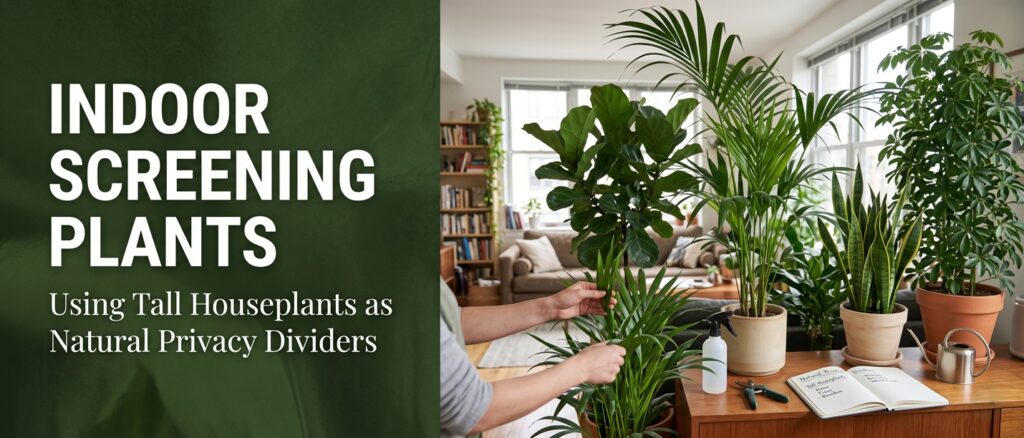
Floor plants anchor the space and define the room's structure. Use 1-3 large floor plants (1-2 meters tall) in corners or beside furniture to create vertical drama. Tabletop plants add detail at eye level when seated — use medium-height plants (30-60 cm) on coffee tables, side tables, and dressers. Shelf and hanging plants fill the upper level and add movement — trailing plants on high shelves, hanging baskets from ceiling hooks, or wall-mounted planters.
Best plants for each height level:
- Floor (1-2 m): Fiddle leaf fig, rubber plant, dracaena marginata, parlor palm, Monstera deliciosa, bird of paradise, kentia palm.
- Tabletop (30-60 cm): Peace lily, Chinese evergreen, calathea, snake plant (dwarf), ZZ plant, anthurium, fittonia in a wide shallow pot.
- Shelf (under 30 cm): Pothos trailing, heartleaf philodendron, string of pearls, air plants, small succulents, fittonia, peperomia.
- Hanging (60+ cm above floor): Spider plant, string of hearts, English ivy, fishbone cactus, trailing philodendron.
Color: Matching Plants to Your Palette
Plant color is more varied than the generic 'green' that comes to mind. Leaves range from deep forest green (monstera, rubber plant) to bright chartreuse (lemon lime maranta, golden pothos) to silvery grey (air plants, silver satin pothos) to dark almost-black (raven ZZ, black velvet alocasia). Some plants offer pink (calathea, aglaonema), red (aglaonema, fittonia), or purple (oxalis, tradescantia) accents. Choosing plants whose colors harmonize with your room's palette is one of the most powerful styling moves you can make.
For a calm minimalist room, choose plants with similar leaf colors — all deep greens, or all silvery greens. Repetition of color creates a cohesive look. For a more eclectic or bohemian space, mix plants with contrasting colors: deep green leaves next to chartreuse, silver next to dark purple. The contrast creates energy and visual interest. Either approach works; the key is intention rather than randomness.
Pot color is equally important. A common mistake is to use pots in many different colors and materials, which fragments the arrangement visually. Pick a limited palette of pot colors — perhaps two complementary colors (white and terracotta, black and cream, charcoal and wood) — and stick with it across all your plants. The pots become a quiet backdrop that lets the plant foliage be the star. Reserve colorful pots for occasional accent pieces, not the entire collection.
Pot Selection: Form Meets Function
Pots are not just containers — they are part of the styling. The right pot can elevate an ordinary plant, while the wrong pot can undermine a beautiful one. Consider three factors when choosing pots: material, color, and proportion. Material (terracotta, ceramic, metal, basket, fabric) sets the visual mood — terracotta is casual and warm, glazed ceramic is more polished, metal is industrial, baskets are rustic and cozy. Match the material to the room's overall feel.
Color should generally be neutral and consistent, as discussed above. Proportion is the most overlooked factor: the pot should be roughly 1/3 the visible height of the plant, with the plant taking up the top 2/3 of the total arrangement. A pot that is too large makes the plant look small and stunted; a pot that is too small looks unstable and out of scale. When in doubt, err on the side of a slightly larger pot for floor plants and a slightly smaller pot for tabletop plants.
⚠️ Warning
Most decorative pots do not have drainage holes, which is a death sentence for most houseplants. Use the cache pot technique: keep the plant in its plastic nursery pot (with drainage holes) and set it inside the decorative pot. For watering, lift the plant out, water it thoroughly in the sink, let it drain, and return it to the decorative pot. This gives you the style you want without sacrificing the drainage your plant needs.
Room-by-Room Plant Styling
Different rooms offer different conditions and call for different plant choices. The living room is usually the largest, brightest space and can support the most diverse plant collection. Use it for your statement floor plants — a fiddle leaf fig in a corner, a Monstera by a window, a bird of paradise framing a view. Add tabletop plants on side tables and trailing plants on high shelves to complete the layered look.
Bedrooms are typically lower-light and benefit from a few well-chosen plants rather than a full collection. A single snake plant or peace lily on a nightstand is enough; both tolerate lower light and are rumored to improve air quality at night. Bathrooms are the opposite — high humidity and often low light, perfect for ferns, calatheas, and air plants that struggle elsewhere in the home. A hanging basket of pothos or a shelf of fittonias can transform a bathroom.
Kitchens are surprisingly good plant spaces if you have window light. Herbs on the windowsill are practical and attractive, and small tropicals like peperomia and pilea add life to the counter without taking much space. Avoid placing plants near the stove or oven where heat and steam will stress them. Home offices benefit from a single statement plant on the desk — a small ZZ or Chinese evergreen adds life without distracting from work.
Best plants for each room:
- Living room: Fiddle leaf fig, Monstera, rubber plant, bird of paradise, kentia palm.
- Bedroom: Snake plant, peace lily, ZZ plant, aloe vera, golden pothos.
- Bathroom: Boston fern, bird's nest fern, calathea, air plants, pothos.
- Kitchen: Herbs (basil, mint, parsley), pothos, spider plant, aloe vera.
- Office: ZZ plant, Chinese evergreen, snake plant, jade, pothos.
- Hallway: Snake plant, ZZ plant, cast iron plant, parlor palm.
Styling Shelves With Plants
Bookshelves and plant shelves are some of the most satisfying spaces to style with plants. The key is to mix plants with books and objects rather than grouping all the plants together. A trailing pothos next to a stack of books, a small succulent beside a framed photo, a taller cactus anchoring a corner — these arrangements feel curated and intentional. Avoid the 'plant shelf' look where every plant is the same size and shape lined up in a row.
Use trailing plants to break the horizontal lines of shelves. A pothos or string of pearls that cascades down from a high shelf softens the rigid geometry of the shelving unit and adds movement. Reserve the upper shelves for trailing plants and the lower shelves for upright plants — this gives the eye a path to follow from top to bottom. Mix in non-plant objects (books, ceramics, art) to create a styled vignette rather than a plant display.
💡 Tip
When styling shelves, use the rule of three: group items in threes (one plant, one book stack, one object) for visual balance. Odd numbers are more pleasing to the eye than even numbers, and groups of three are the most versatile. Vary the heights within each trio so the eye moves naturally through the arrangement.
Avoiding Common Styling Mistakes
The most common plant styling mistake is overcrowding. A room with too many plants feels cluttered and chaotic, no matter how healthy each individual plant is. As a general rule, leave breathing room around each plant — at least 15-20 cm of empty space between a plant and any other object. This lets each plant be appreciated individually and prevents the arrangement from looking like a plant shop.
Other common mistakes include: matching pots too precisely (a little variation is more interesting than perfect uniformity); using pots without drainage (which kills the plants you are trying to display); choosing plants that are too small for their location (a tiny plant in a large corner looks lost); and forgetting that plants grow (a small plant in a perfect spot may outgrow it within a year). Plan for the mature size of the plant, not the size you are buying.
Above all, plant styling should be an expression of your personal taste. Use the principles here as guidelines, not rules — if a particular arrangement feels right to you, it is right, even if it breaks a 'rule.' The goal is to create spaces that you love living in, with plants as integral parts of the design rather than afterthoughts. Experiment, rearrange, and trust your eye as much as the principles.
Only logged-in users can comment
Sign in or create a free account to join the conversation — it takes less than a minute.