

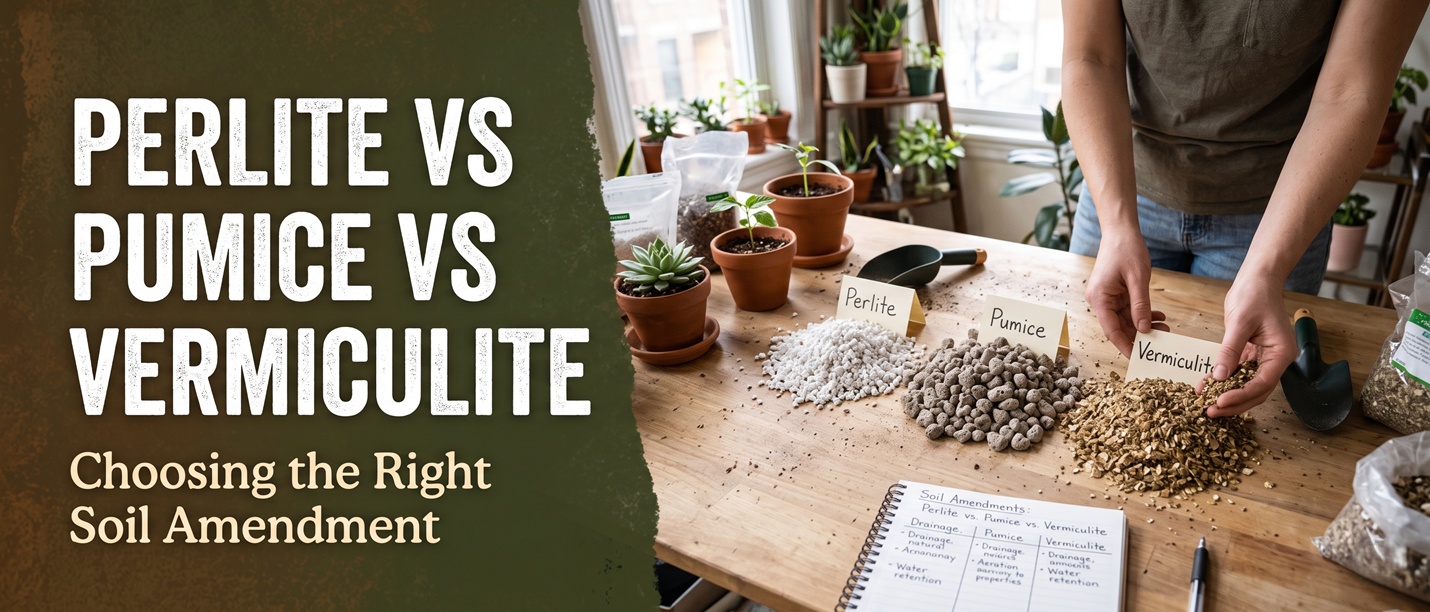
Why Soil Amendments Matter More Than Soil
Walk into any garden center and you will find bags of perlite, pumice, and vermiculite sitting next to each other, all looking like small white or brown chunks. These three amendments are the workhorses of soil mixing — they are what separate a soggy, root-rotting potting mix from a fast-draining, root-friendly one. Yet most plant owners use them interchangeably or pick whichever is cheapest, which is a mistake. Each amendment has distinct physical properties that make it suitable for specific plants and growing situations.
The core function of all three is to modify the physical structure of potting soil. Plain potting soil compacts over time, suffocating roots. Amendments create air pockets, regulate moisture, and prevent compaction. But they do this in different ways: perlite primarily adds drainage, pumice adds aeration while holding some moisture, and vermiculite primarily adds water and nutrient retention. Choosing the wrong one for your plant can mean the difference between a thriving specimen and a chronically unhappy one.
💡 Tip
If you can only stock one amendment, choose pumice. It is the most versatile — it provides both drainage and moisture retention, does not float to the surface like perlite, and works for everything from succulents to tropical foliage plants. Perlite and vermiculite are more specialized and easier to misuse.
Perlite: The Drainage Specialist
Perlite is a volcanic glass that has been heated to 900°C until it pops like popcorn, expanding to 13 times its original volume. The result is a lightweight, porous white material that is essentially sterile and pH-neutral. Perlite's defining characteristic is that it holds very little water — most of its volume is air. When mixed into soil, it creates air pockets and improves drainage, allowing water to flow through the pot quickly. This makes perlite the amendment of choice for plants that hate wet feet: cacti, succulents, orchids, and most Mediterranean herbs.
Perlite has three notable downsides. First, it floats — when you water a pot with high perlite content, the perlite gradually migrates to the soil surface, leaving the deeper soil denser over time. Second, it produces fine dust when handled dry that is harmful to inhale; always wet perlite before mixing and wear a dust mask. Third, perlite is fragile and crushes into dust over years of root activity, eventually losing its drainage benefits and needing to be replaced when you repot. Despite these limitations, perlite remains the most widely used drainage amendment because it is cheap, lightweight, and effective.
Best uses for perlite:
- Cactus and succulent soil mixes (50 percent perlite, 50 percent potting soil)
- Seed starting mix (adds drainage without adding nutrients that could burn seedlings)
- Orchid bark mix supplementation (improves drainage in moisture-retentive mixes)
- Propagation mix for rooting cuttings (prevents rotting at the stem base)
- Any plant that chronically suffers from overwatering (add 30 percent perlite to standard mix)
Pumice: The Versatile All-Rounder
Pumice is also volcanic, but unlike perlite, it is mined as a natural solid rather than manufactured through heating. Pumice is essentially solidified volcanic foam — full of microscopic air bubbles trapped when the lava cooled rapidly. These bubbles give pumice its unique property: it absorbs water into its pores (holding roughly 30-40 percent of its volume in water) while still providing excellent aeration. Pumice does not float, does not crush easily, and lasts essentially forever in potting soil.
The main downside of pumice is its weight. A bag of pumice weighs 2-3 times as much as the same volume of perlite, which matters for hanging baskets and large pots that need to be moved. Pumice is also more expensive than perlite in many regions and harder to find in small garden centers. Despite this, professional growers increasingly prefer pumice for premium potting mixes because its durability and balanced moisture-air profile produce healthier root systems over the long term. For houseplant owners willing to spend a bit more, pumice is the best single amendment.
Pumice comes in different sizes, and the size matters as much as the material. Fine pumice (1-3 mm) works well in seed starting and propagation mixes. Medium pumice (3-8 mm) is the standard for general houseplant and succulent mixes. Coarse pumice (8-15 mm) is used as a top dressing for bonsai and orchids, or as a drainage layer at the bottom of large pots. Choose the size based on the plant — small plants and seedlings need finer grades; mature plants tolerate and benefit from coarser grades.
Vermiculite: The Water Holder
Vermiculite is a completely different mineral — a hydrated magnesium-aluminum-iron silicate that expands when heated, producing golden-brown accordion-like chunks. Unlike perlite and pumice, vermiculite is excellent at holding water, absorbing 3-4 times its volume in moisture. It also has a high cation exchange capacity, meaning it holds nutrients (potassium, magnesium, calcium) and releases them slowly to plant roots. This makes vermiculite the amendment of choice when you want moisture retention rather than drainage.
Use vermiculite for plants that like consistently moist soil: ferns, calatheas, marantas, seedlings, and moisture-loving tropicals. It is also excellent in seed starting mix because it holds water around germinating seeds without suffocating them. Never use vermiculite for cacti, succulents, or other drought-tolerant plants — it will keep them too wet and cause root rot. Vermiculite is also more fragile than perlite and breaks down faster, so it is not ideal for long-term potted plants that you do not repot annually.
⚠️ Warning
Old vermiculite insulation (pre-1990) sometimes contained asbestos, but the vermiculite sold for horticultural use today is tested and certified asbestos-free. If you have very old bags of unknown provenance, dispose of them safely and buy new product. Modern horticultural vermiculite is completely safe to handle.
Side-by-Side Comparison
Quick comparison of the three amendments:
- Water holding: Vermiculite (very high) > Pumice (medium) > Perlite (very low)
- Drainage improvement: Perlite (very high) > Pumice (high) > Vermiculite (low)
- Aeration: Pumice (excellent) > Perlite (good) > Vermiculite (moderate)
- Weight: Pumice (heavy) > Vermiculite (medium) > Perlite (very light)
- Durability: Pumice (lifetime) > Perlite (2-4 years) > Vermiculite (1-2 years)
- Floats in water: Perlite (yes, badly) > Vermiculite (slightly) > Pumice (no)
- Nutrient retention: Vermiculite (high CEC) > Pumice (low) > Perlite (none)
- Best for drainage plants: Perlite or Pumice
- Best for moisture plants: Vermiculite
- Best all-purpose: Pumice
Recipe Recommendations by Plant Type
For cacti and succulents, mix 50 percent potting soil with 50 percent perlite or pumice. The high amendment ratio ensures fast drainage and prevents the chronic wet conditions that cause succulent root rot. Add a handful of coarse sand or grit for extra drainage if you tend to overwater. For tropical foliage plants (monstera, philodendron, pothos, aglaonema), use 60 percent potting soil, 30 percent perlite or pumice, and 10 percent orchid bark or coco chips. This balances drainage with enough moisture retention to support active growth.
For ferns, calatheas, and marantas, use 50 percent potting soil, 30 percent perlite, and 20 percent vermiculite. The vermiculite holds moisture between waterings without causing the soil to become waterlogged. For seed starting, use 50 percent vermiculite and 50 percent perlite with no soil — this sterile mix holds moisture around seeds while providing enough aeration to prevent damping-off disease. For propagation of cuttings, use 50 percent perlite and 50 percent vermiculite, which provides moisture without being too dense for new roots to push through.
Cost and Sourcing Considerations
Perlite is the cheapest of the three — a 8-liter bag typically costs $5-8. Vermiculite is similar in price, sometimes slightly more. Pumice is the most expensive at $10-15 for an 8-liter bag, and may need to be ordered online if not available locally. For large collections, the cost difference adds up; many growers use perlite for most plants and reserve pumice for special specimens. All three are available in bulk online at significantly lower per-liter prices than small garden-center bags.
If you have access to a bonsai or hydroponic supply store, you will find higher-quality grades of all three amendments than at general garden centers. The horticultural-grade perlite sold at hydroponic stores has larger, more uniform particles than the dust-heavy bags at big-box stores. Bonsai-grade pumice (often sold as 'haydite' or 'acidanthera') is screened to specific sizes that work better than generic pumice. For serious plant collectors, sourcing from specialty suppliers is worth the extra effort.
💡 Tip
Mix amendments into potting soil outdoors or in a well-ventilated area, and wet them slightly first to control dust. Perlite dust is the main respiratory concern — the particles are sharp glass shards that can irritate lungs. A simple N95 mask eliminates the risk. Once wetted and mixed, the amendments are completely safe to handle.


Only logged-in users can comment
Sign in or create a free account to join the conversation — it takes less than a minute.