

What a Self-Watering Planter Actually Does
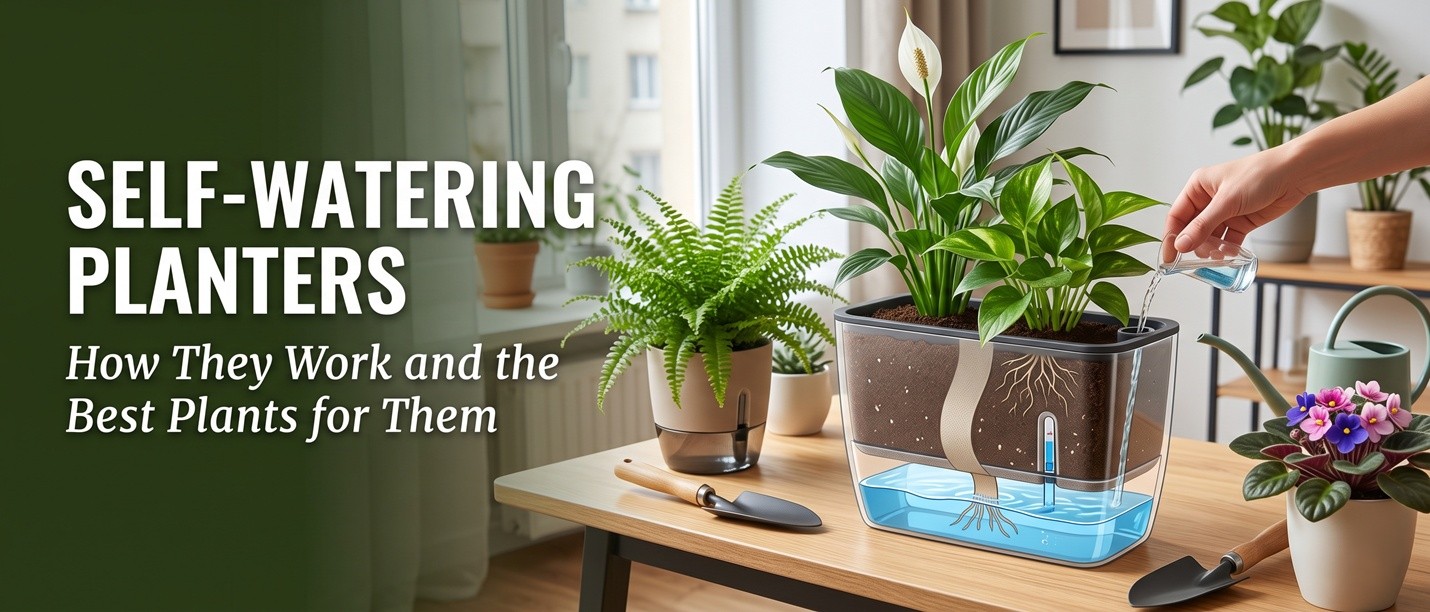
A self-watering planter is not a magic device that waters your plant perfectly without any input from you. It is a cleverly designed container with two chambers: a soil pot on top, and a water reservoir below, separated by a false bottom or aeration screen. The connection between the two is a wicking mechanism — usually a column of soil, a fabric wick, or both — that draws water up from the reservoir into the root zone by capillary action. The plant's roots effectively drink from the reservoir at their own pace, and you refill the reservoir every 1-3 weeks depending on plant size, temperature, and growth rate.
The key insight is that the plant itself regulates the watering rate. As roots absorb moisture from the wicking column, more water is drawn up from the reservoir to replace it. The system reaches equilibrium when the soil moisture matches the plant's uptake rate. This eliminates both overwatering (because excess water simply sits in the reservoir, not in the root zone) and underwatering (because the reservoir provides a buffer of 1-3 weeks before the soil dries out). For moisture-loving plants, this is the closest thing to foolproof watering that exists.
💡 Tip
Self-watering planters do not eliminate the need to check your plant. They eliminate the need to water on a schedule. You still need to refill the reservoir before it runs dry, monitor the plant for signs of stress, and flush the system periodically to prevent salt buildup. Think of them as a buffer, not a substitute for engagement.
The Anatomy of a Self-Watering Planter
Every self-watering planter has five essential components:
- Outer pot / reservoir container — holds water, typically 1-5 liters depending on pot size
- Inner pot / growing chamber — holds soil and roots, has holes or a mesh bottom for wicking
- Wicking column — a column of soil, fabric, or cord that connects the reservoir to the root zone
- Fill tube — a vertical pipe or opening through which you add water to the reservoir
- Overflow drain / water level indicator — prevents overfilling and shows reservoir level at a glance
The wicking column is the heart of the system. It works through capillary action — the same physical force that lets a paper towel soak up water. The small pore spaces in the wicking material pull water upward against gravity, and the rate of wicking is determined by the material (soil wicks slowly and steadily; fabric wicks faster; cord wicks fastest of all). The column must be in direct contact with both the reservoir water and the root zone; any gap breaks the capillary chain and the system fails.
Best Plants for Self-Watering Planters
Plants that appreciate consistent moisture are the ideal candidates for self-watering planters. These are typically tropical foliage plants from rainforest understory habitats, leafy vegetables, and most kitchen herbs. The constant moisture encourages lush, healthy growth without the stress of repeated wet-dry cycles. Plants that thrive include peace lilies, pothos, philodendrons, ferns, calatheas, marantas, fittonias, and most aroids. Herbs like basil, mint, parsley, and cilantro also do exceptionally well — the consistent moisture prevents bolting and extends harvest.
Vegetable container gardening is where self-watering planters truly shine. Tomatoes, peppers, eggplants, cucumbers, and leafy greens like lettuce, spinach, and Swiss chard all produce dramatically higher yields in self-watering containers compared to conventional pots. The reason is that fruiting vegetables have very high water demand during fruit set, and any dry spell causes blossom drop or bitter fruit. Self-watering planters provide the consistent moisture these plants need without requiring twice-daily hand watering in summer heat.
Best plants for self-watering planters (consistent moisture lovers):
- Peace lily (Spathiphyllum) — loves the constant moisture and produces blooms reliably
- Pothos and Philodendron — fast-growing vines that appreciate the moisture buffer
- Calathea and Maranta — eliminates the brown tipping caused by inconsistent moisture
- Boston fern and bird's nest fern — flourish without daily misting
- Fittonia and Hypoestes — no more dramatic wilting when you forget to water
- Basil, mint, parsley, cilantro — extended harvest, less bolting
- Tomatoes, peppers, eggplants — dramatically higher fruit yields
- Lettuce, spinach, Swiss chard — crisp leaves, no bitterness
- Strawberries — consistent moisture means larger, sweeter berries
- African violets and Streptocarpus — perfect bottom-watering plants
⚠️ Warning
Do NOT put succulents, cacti, snake plants, ZZ plants, ponytail palms, or any other drought-tolerant plant in a self-watering planter. These plants evolved to survive dry periods by storing water in their tissues, and constant moisture will rot their roots within weeks. Even with a slow-wicking soil mix, the moisture level in a self-watering planter never drops low enough to satisfy these plants.
Worst Plants for Self-Watering Planters
Drought-tolerant plants are the worst candidates because their root systems are adapted to dry conditions and rot easily in consistently moist soil. This includes all succulents (echeveria, sedum, kalanchoe, aeonium), all cacti (desert and forest), snake plants (Sansevieria), ZZ plants (Zamioculcas), ponytail palms, jade plants (Crassula), and most Mediterranean herbs like rosemary, thyme, lavender, and oregano. If you absolutely must use a self-watering planter for one of these, only fill the reservoir every 3-4 weeks and let it run completely dry between refills — but this defeats the purpose of the system.
Orchids are another poor candidate for most commercial self-watering planters. Orchid roots need to dry completely between waterings and require abundant airflow around the roots. The closed environment of a self-watering planter suffocates orchid roots and promotes bacterial rot. There are specialized orchid self-watering pots with extra ventilation, but even these are controversial among orchid growers. Stick to traditional orchid bark culture for these plants.
Setting Up a Self-Watering Planter Correctly
The soil mix you use in a self-watering planter is critical to its success. The soil must wick moisture effectively from the reservoir to the root zone, but it must also drain well enough to prevent waterlogging in the upper layers. A good self-watering mix is 50 percent peat moss or coco coir (for wicking and moisture retention), 30 percent perlite or pumice (for aeration and drainage), and 20 percent compost or worm castings (for nutrients). Avoid heavy garden soil or pure potting soil — they compact over time and stop wicking.
When potting the plant, fill the bottom of the inner pot with the soil mix, making sure the wicking column is in direct contact with the soil. Plant the plant at the same depth it was in its previous pot, firm the soil gently around the roots, and water the soil from the top once to settle it. Then fill the reservoir through the fill tube until water flows from the overflow drain. For the first 2-3 weeks, monitor the soil moisture daily — the wicking system takes time to establish, and the plant may need top watering while the wick gets going.
Maintenance: The Hidden Costs
Self-watering planters are not maintenance-free. Three ongoing tasks are required to keep the system working. First, refill the reservoir before it runs dry — usually every 1-2 weeks for actively growing plants, longer in winter. Letting the reservoir run dry breaks the wicking chain, and the system will not restart automatically when you refill. After a dry-out, water from the top to re-establish the capillary connection.
Second, flush the system every 4-6 weeks to remove accumulated salts from fertilizer and tap water. These salts build up in the reservoir and root zone, eventually burning roots and causing leaf tip browning. To flush, remove the inner pot and run 3-4 liters of clean water through the soil, allowing it to drain completely. Refill the reservoir with fresh water. Third, clean the reservoir thoroughly at the end of each growing season — algae, mineral deposits, and root infiltration can clog the wicking column over time.
💡 Tip
Add a small amount of liquid fertilizer to the reservoir every 2-3 weeks instead of fertilizing through the soil. The wicking system will deliver nutrients directly to the roots at the same rate as water. Use a balanced fertilizer at quarter strength to avoid salt buildup, and skip fertilizing for one cycle each month to let the system recover.
DIY vs Commercial Self-Watering Planters
Commercial self-watering planters range from $15 for small tabletop units to $80+ for large patio containers. The better ones have water level indicators, large reservoirs, and easily removable inner pots for cleaning. Cheaper models often have tiny reservoirs that need refilling every 3-4 days (defeating the purpose) and no way to clean the reservoir. If you buy commercial, look for ones with a 2-liter or larger reservoir, a clear water level indicator, and an inner pot that lifts out.
DIY self-watering planters are easy and cheap to make from two plastic buckets or storage tubs. Drill holes in the inner container for the wicking column (a 5 cm hole in the center plus smaller drainage holes around it), use a plastic cup or PVC pipe filled with soil as the wick, add a fill tube made from a piece of PVC pipe, and drill an overflow hole in the outer container just below the inner container's bottom. Total cost is about $10-15, and you can size the system to fit any plant. Plans are widely available online — search for 'EarthBox DIY' or 'global bucket' for proven designs.
Common Problems and Solutions
If the soil in your self-watering planter stays bone dry despite a full reservoir, the wicking chain has broken. Remove the inner pot and check that the wicking column is in contact with both the reservoir water and the soil. Re-establish contact, water from the top once to start the capillary action, and wait 24 hours for the system to equilibrate. If the soil stays soggy and the plant shows signs of overwatering (yellowing, wilting), the wicking column is too large or the soil is too dense — replace with a smaller wick and a lighter mix.
Algae growth in the reservoir is harmless but unsightly. Block light from reaching the reservoir by covering the fill tube, using an opaque outer container, or adding a few drops of hydrogen peroxide to the water each refill. Mosquitoes breeding in the reservoir is a more serious problem in tropical climates — prevent this by covering the fill tube with fine mesh or adding BTI (Bacillus thuringiensis israelensis) dunks to the water. The dunks kill mosquito larvae but are completely safe for plants, pets, and people.
Only logged-in users can comment
Sign in or create a free account to join the conversation — it takes less than a minute.