

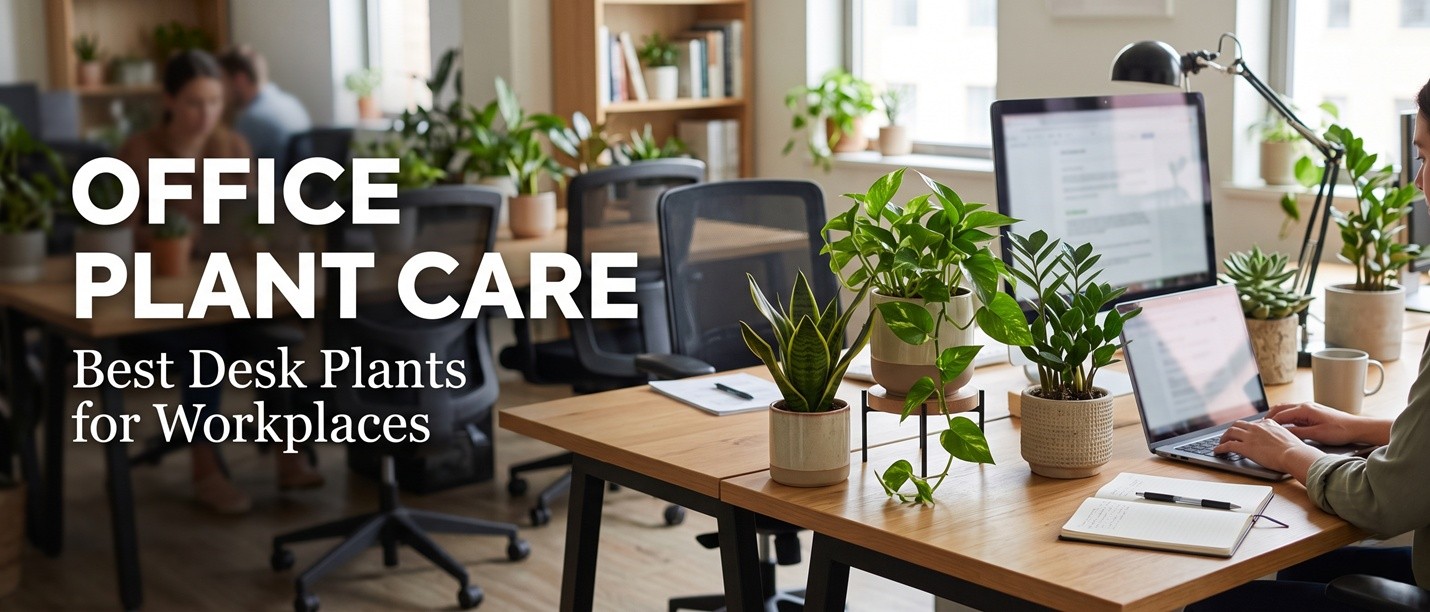
Why Offices Are Harder on Plants Than Homes
Offices combine three plant-hostile factors that homes rarely stack together: air conditioning that runs constantly during work hours and shuts off on weekends, fluorescent or LED lighting that has the right spectrum but only a fraction of the intensity of daylight, and an empty office on weekends that can swing 10 degrees in temperature. Add in dust from HVAC systems and the occasional missed watering due to a busy week, and you have an environment where most houseplants slowly decline.
The good news is that a small set of plant species have evolved to handle exactly these conditions. They come from the forest understory where light is dim and seasonal, and they have thick leaves or storage organs that buffer them through irregular watering. Pick from this group, set up a sensible watering routine, and your office plant will outlive your laptop. Pick the wrong plant — a moisture-loving fern or a sun-loving succulent — and it will be yellow and leggy within a month.
💡 Tip
The single best predictor of office plant survival is leaf thickness. Thick, leathery, or waxy leaves (snake plant, ZZ, rubber plant, pothos) store water and resist dry air. Thin, delicate leaves (maidenhair fern, calathea, fittonia) lose water fast and demand consistent humidity that offices cannot provide.
The 12 Best Office Plants, Ranked
These are plants that consistently survive in office conditions: fluorescent lighting 10 hours a day, AC running during business hours, no care on weekends, and only occasional watering. They are listed roughly in order of toughness, with the most bulletproof options first.
Top 12 office desk plants:
- ZZ Plant (Zamioculcas zamiifolia) — the undisputed champion of low light and neglect. Can go 3-4 weeks between waterings.
- Snake Plant (Sansevieria trifasciata) — handles dim corners and dry air equally well. Water every 2-3 weeks.
- Pothos (Epipremnum aureum) — trails nicely from a shelf, tolerates fluorescent light, tells you when it needs water by drooping.
- Chinese Evergreen (Aglaonema) — colorful foliage in low light, very forgiving of irregular watering.
- Cast Iron Plant (Aspidistra elatior) — earned its name in Victorian-era dim parlors; nearly indestructible.
- Peace Lily (Spathiphyllum) — handles low light, dramatic wilt-and-recover cycle suits forgetful waterers.
- Spider Plant (Chlorophytum comosum) — tolerant and productive, will make babies you can give to coworkers.
- Rubber Plant (Ficus elastica) — a larger floor plant that tolerates office light if it gets a window nearby.
- Lucky Bamboo (Dracaena sanderiana) — grows in water alone, perfect for desks with no soil-spill risk.
- Philodendron hederaceum — heartleaf philodendron is as forgiving as pothos, with a softer look.
- Jade Plant (Crassula ovata) — needs a windowsill but otherwise bulletproof; do not overwater.
- Air Plant (Tillandsia) — needs no soil and only a weekly soak; great for attaching to monitors.
Light in Offices: What Counts as 'Low Light'
Office lighting is measured in lux, and a typical office environment is around 300-500 lux at desk height. By comparison, a north-facing window delivers 1,000-2,000 lux and a south-facing window can hit 10,000+ lux. Plants evolved for the forest floor can survive at 300 lux, but they will grow very slowly and may lose variegation over time. Pure fluorescent light is fine for these plants because the spectrum is broad enough, but the intensity is the limiting factor.
If your desk has no window within 3 meters, stick to the top four plants on the list above. They will survive but not thrive. If you have a window seat, even a north-facing one, you can branch out into peace lilies, spider plants, and trailing philodendrons. Anything labeled 'bright indirect light' on its care tag is unlikely to survive long-term on a windowless desk — it will live for a few months, gradually yellow, and then collapse.
⚠️ Warning
Beware the 'office window' that turns out to face a brick wall or an interior atrium. What looks like daylight to your eye may be only 200 lux. If your plant is not growing at all after 3 months — no new leaves, no extension of trailing stems — the light is too low and you need to either move the plant or supplement with a small clip-on grow light.
Watering Around a 5-Day Work Week
The biggest mistake office plant owners make is watering on a fixed schedule regardless of soil moisture. Offices are dry and plants in small pots can dry out in 4-5 days, but a snake plant or ZZ in the same office might need water only every 3 weeks. Establish a weekly check-in: every Monday (or whatever day starts your week), walk around and stick your finger 2-3 cm into the soil of each plant. Water only the ones that feel dry at that depth.
For weekend watering, the rule is: do not. Plants survive the weekend fine on their own — the AC is off, the lights are off, and transpiration slows dramatically. Watering on Friday before you leave risks root rot if the soil stays wet through Monday morning. Water Monday morning instead, after you have assessed what actually needs it. This also lets you catch any plants that died or were knocked over during the weekend before they sit in soggy soil for another week.
💡 Tip
Keep a small watering can or even a recycled water bottle at your desk. The friction of going to a sink and back is enough to make you skip waterings. Make the act so easy that you do it on impulse when you check the soil.
Air Conditioning and Heating Vents
Air conditioning is rough on plants in two ways. First, it dries the air: an AC-cooled office typically runs at 30-40 percent relative humidity, which is below what most tropical houseplants prefer. Second, the airflow itself accelerates transpiration — a constant breeze across the leaves pulls moisture out faster than still air. The fix is placement: never put a plant directly under or beside an AC vent. If your desk is in the path of a vent, choose snake plant, ZZ, or jade, which tolerate dry air better than most.
In winter, heating vents cause the same problem in reverse — they blow warm dry air that desiccates plants. The same placement rule applies. If you cannot move the plant, create a buffer with a row of books, a monitor, or a small partition that deflects the direct airflow. Misting is sometimes recommended for office plants but the effect lasts only minutes; a small humidifier is far more effective if your office permits one.
What to Avoid: Office Plant Failure Modes
Some plants are office-kryptonite and will fail no matter how careful you are. Anything sold as a 'terrarium plant' (fittonia, baby tears, most ferns) needs humidity above 60 percent that offices cannot provide. Succulents other than jade and haworthia need direct sun that offices lack. Flowering plants like African violets and orchids need more light and consistent care than a workplace schedule supports. And anything in a tiny decorative pot with no drainage hole is a slow-motion root rot experiment.
Common office plant failure modes:
- Buying a moisture-loving plant (fern, calathea, fittonia) and watching it crisp up in 2 weeks.
- Putting a succulent on a windowless desk — it etiolates into a pale stretched-out version of itself.
- Watering on a fixed Friday schedule regardless of soil moisture — root rot is the #1 office plant killer.
- Letting coffee or sugary drinks get tipped into the pot — ants and fruit flies follow within days.
- Repotting into a too-large container with dense potting soil — stays wet for weeks, root rot follows.
- Ignoring dust buildup on leaves, which blocks light and stresses the plant further.
Building an Office Plant Routine That Lasts
Sustainable office plant care comes down to a 5-minute Monday check-in. Walk the plants, finger-test the soil, water what is dry, rotate each pot a quarter turn so the plant grows evenly, and wipe any dusty leaves with a damp paper towel. Once a month, take a closer look for pests, yellowing leaves, and root-bound symptoms. This routine, done consistently, will keep your office plants alive for years.
Finally, accept that some plants will need to be replaced. An office plant that has declined past recovery is not a failure — it is information about which species work in your specific spot. Replace it with something from the top of the toughness list, and over time your office collection will converge on the species that genuinely thrive in your conditions. The goal is not to keep every plant alive forever; it is to find the plants that flourish where you actually work.

Only logged-in users can comment
Sign in or create a free account to join the conversation — it takes less than a minute.