

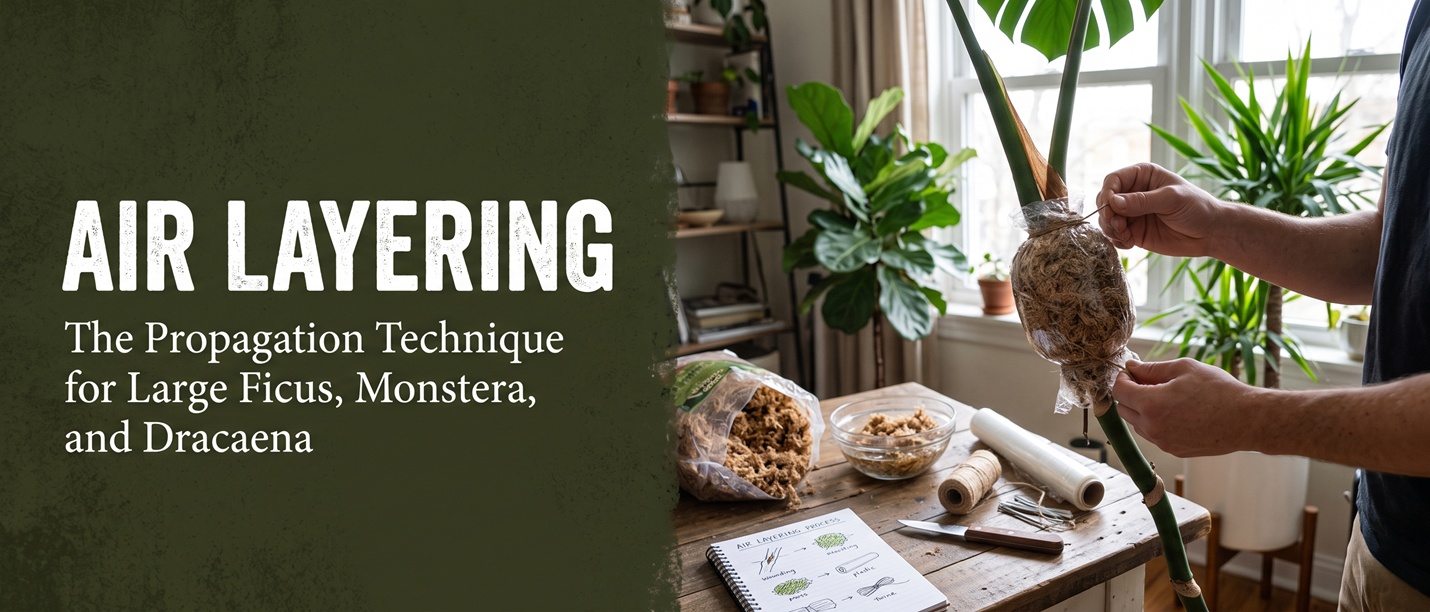
Why Air Layering Beats Cuttings for Large Plants
Standard stem cuttings work well for small, soft-stemmed plants, but they struggle with large woody houseplants. A cutting from a mature Ficus elastica or Dracaena marginata may take 3–6 months to root, and the resulting plant starts as a single thin stick with two or three leaves. To grow a finished specimen takes years. Air layering solves both problems by rooting a branch while it is still attached to the parent plant, with full access to water and nutrients.
Because the layered branch is still connected to the parent's root system, it can grow substantial roots over 6–12 weeks without the wilting and stress that plague traditional cuttings. When you eventually cut the layered branch free, you have a sizable new plant with a developed root system, not a struggling stick. This makes air layering the technique of choice for propagating large statement plants like mature fiddle leaf figs, rubber plants, and tall dracaenas.
💡 Tip
Air layering is also the safest way to propagate a treasured plant. If the layering fails, you have lost nothing but a small section of bark — the parent plant is unharmed and you can try again. With traditional cuttings, a failure means losing the cutting entirely.
When to Air Layer
The best time to air layer is late spring or early summer, when the plant is in active growth. Warm temperatures and long days speed root formation, and the plant has plenty of energy to direct toward the new roots. Layers started in spring can usually be separated by mid-summer; layers started in autumn may take all winter and risk rotting before roots form.
Choose a healthy branch or stem at least pencil-thick (1 cm or more in diameter). The branch should be at a height where you can comfortably work on it, and should have several leaves above the layering site that will become the new plant's canopy. Avoid branches with flowers or fruit, which divert energy from root formation.
Materials You Will Need
Air layering requires a small kit of supplies, most of which can be reused across multiple layers. The total cost per layering is negligible compared to the value of the new plant you produce.
Materials for air layering:
- Sphagnum moss (long-fiber, not peat moss) — pre-soaked in water for 30 minutes
- Clear plastic wrap (kitchen cling wrap works) — to wrap the moss and retain moisture
- Aluminum foil — to cover the plastic wrap and block light (roots prefer darkness)
- Twist ties or electrical tape — to seal the top and bottom of the wrap
- Sharp sterile knife — for making the wound
- Rooting hormone powder (optional but recommended) — IBA 0.1% to 0.3%
- Small brush or cotton swab — to apply rooting hormone
Step-by-Step Air Layering Technique
The technique involves wounding the stem in a way that interrupts the flow of auxin (the hormone that suppresses root formation) down the bark, while leaving the central xylem intact so the branch above the wound still receives water. The wound is then wrapped in moist sphagnum moss, which provides the humidity and aeration needed for root formation.
Step-by-step air layering procedure:
- Select the layering site on a healthy branch 30–60 cm below the growing tip.
- Make two parallel cuts around the stem, 2–3 cm apart, cutting through the bark and cambium layer but NOT into the white central wood (xylem).
- Connect the two cuts with a vertical cut and peel off the ring of bark. This is called a 'girdle'.
- Lightly scrape the exposed surface to remove any remaining green cambium cells — these would otherwise heal the wound.
- Brush rooting hormone onto the upper edge of the wound (where roots will form).
- Take a generous handful of pre-soaked sphagnum moss, squeeze out excess water, and pack it firmly around the wound, covering 5 cm above and below the cut.
- Wrap clear plastic around the moss, sealing top and bottom with twist ties or tape so moisture cannot escape.
- Wrap aluminum foil over the plastic to block light and prevent the moss from overheating in direct sun.
- Check the moss moisture monthly by opening a small slit — if dry, add water with a syringe and reseal.
⚠️ Warning
The most common failure point is cutting too deep. If you cut into the central white wood (xylem), you cut off the water supply to the branch above the layer. The branch will die within weeks. Cut only through the dark bark and the thin green cambium layer beneath — stop as soon as you see white wood.
What Happens Over the Next 6–12 Weeks
Over the first two weeks, the wound calluses and the rooting hormone stimulates root initiation. By 4–6 weeks, white root tips should be visible through the plastic wrap if you used clear wrap. By 8–12 weeks, the root ball should be dense enough to support the branch independently. Faster-growing plants (pothos, philodendron) may root in 4–6 weeks; slower woody plants (ficus, dracaena) may need 12–16 weeks.
Check the wrap monthly by gently squeezing it. If the moss feels dry, water it through a small slit with a syringe or turkey baster. If the wrap feels soggy, open the top slightly to allow some air exchange. Avoid opening the wrap fully until you are ready to separate the layer — each opening sets back the rooting process by exposing the tender new roots to dry air.
Separating and Potting the Layer
When the wrap is full of healthy white roots visible from all sides, the layer is ready to separate. Cut the branch just below the root ball — below the original girdle wound, not above it — using sharp sterile secateurs. The new plant now has its own root system and a sizable canopy of leaves above.
Pot the new plant into a container just slightly larger than the root ball, using a well-draining potting mix. Water thoroughly and place in bright indirect light, away from direct sun for the first two weeks. Expect some transplant shock — the plant is adjusting from a moss environment to a soil environment, and some lower leaves may yellow. New growth within 4–6 weeks is the sign that the new plant has established.
💡 Tip
The parent plant, now missing its top, will usually push 2–3 new shoots from nodes below the cut. This creates a bushier parent plant as a bonus, making air layering the rare propagation technique that improves both the new plant and the original.
Plants That Respond Best to Air Layering
Air layering works best on plants with woody or semi-woody stems. The technique is reliable on all Ficus species (rubber plant, fiddle leaf fig, benjamina, lyrata), Monstera deliciosa (especially large mature specimens with thick stems), Dracaena species (marginata, fragrans, reflexa), Codiaeum (croton), and Magnolia. It can also work on woody herbs like rosemary and bay laurel, though these are easier from cuttings.
Air layering does not work well on succulents (the wound tends to rot before roots form), thin-stemmed tropicals (the girdle wound is too small to be effective), or plants with very soft herbaceous stems. For these plants, use water propagation, stem cuttings in perlite, or leaf cuttings as appropriate.






Only logged-in users can comment
Sign in or create a free account to join the conversation — it takes less than a minute.