

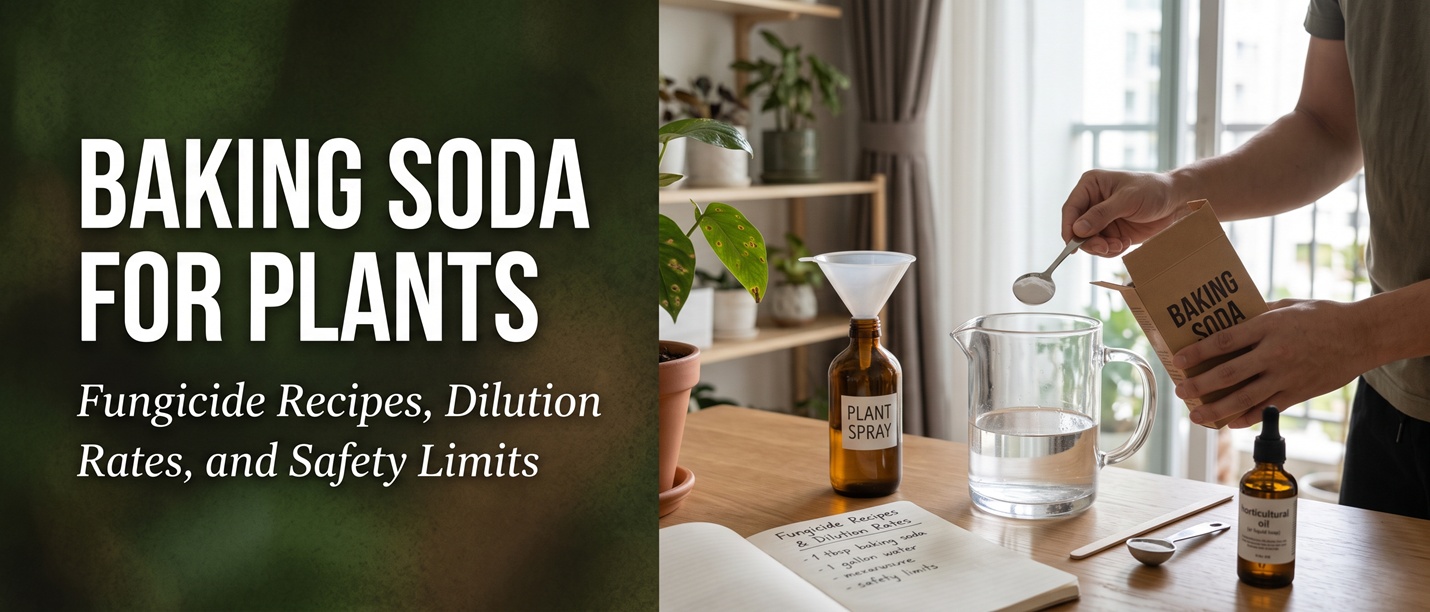
What Baking Soda Actually Does to Plant Fungi
Baking soda (sodium bicarbonate) works as a fungicide through two mechanisms. First, it raises the pH of the leaf surface, making it alkaline enough that most fungal spores cannot germinate. Most plant pathogenic fungi require a slightly acidic surface (pH 5-7) to infect leaves; baking soda raises the surface pH to 8-8.5, which prevents germination. Second, the bicarbonate ion itself disrupts fungal cell walls, causing the spores and hyphae to rupture and die. The effect is preventive rather than curative — baking soda stops new infections but does not kill established mycelium inside the leaf.
This preventive-only action is the source of most baking soda disappointments. Gardeners spray it on a plant that already has visible powdery mildew or black spot, see no improvement, and conclude that baking soda does not work. In reality, baking soda applied before symptoms appear can prevent the disease entirely, but applied after the fungus is established it can only slow the spread, not reverse the damage. Understanding this limitation is the key to using baking soda effectively.
💡 Tip
Baking soda works best as part of a preventive spray program applied every 7-14 days during humid weather when fungal diseases are likely. Once you see symptoms, switch to a curative fungicide (neem oil, copper, or sulfur) and reserve baking soda for prevention on healthy plants nearby.
The Correct Dilution: Not as Strong as You Think
The most common mistake with baking soda fungicide is using too high a concentration. Recipes online often call for 1-2 tablespoons per gallon, which is 4-8 times stronger than needed and will burn plant leaves, especially in sunny or hot conditions. The correct concentration, confirmed by university plant pathology research, is 1 teaspoon (5 grams) of baking soda per 1 liter (quart) of water. This produces roughly a 0.5 percent solution, which is strong enough to suppress fungal spores but weak enough to avoid leaf damage on most plants.
Always add 1 teaspoon of light horticultural oil or 1 drop of mild liquid dish soap per liter as a spreader-sticker. Baking soda solution on its own beads up and rolls off the waxy leaf surface, leaving no protective film. The oil or soap breaks the surface tension and helps the solution stick to the leaf, dramatically improving effectiveness. Without a spreader-sticker, the baking soda does almost nothing because it never actually contacts the leaf surface.
Standard baking soda fungicide recipe (1 liter):
- 1 teaspoon (5 g) baking soda (sodium bicarbonate, NOT baking powder)
- 1 teaspoon (5 ml) light horticultural oil OR 1 drop mild liquid dish soap
- 1 liter (1 quart) lukewarm water
- Mix thoroughly until baking soda is fully dissolved
- Use immediately — do not store mixed solution
- Pour into a spray bottle and apply to both leaf surfaces until runoff
⚠️ Warning
Do NOT exceed 1.5 teaspoons of baking soda per liter. Higher concentrations cause leaf burn, especially on thin-leaved plants like ferns, calatheas, and African violets. Test any new spray on a single leaf and wait 48 hours before spraying the entire plant. If the test leaf shows browning, scorching, or yellowing, dilute further or skip baking soda entirely on that species.
Which Diseases Baking Soda Actually Treats
Baking soda is most effective against powdery mildew, the white fuzzy fungus that appears on leaves of cucumbers, squash, roses, phlox, monardas, and many houseplants. Powdery mildew spores germinate best at high humidity with dry leaf surfaces, and baking soda's pH-raising effect directly interferes with their germination. Regular preventive sprays during humid weather can keep powdery mildew off susceptible plants entirely.
Baking soda also provides moderate control of black spot on roses, anthracnose on various ornamentals, early blight on tomatoes, and some leaf spot diseases. It is less effective against soil-borne fungi, root rot, and established fungal infections inside plant tissue. For houseplants, baking soda can help with powdery mildew on begonias, African violets, and grape ivies, and with leaf spot on fiddle leaf figs. It is not effective against bacterial infections, viral infections, or insect pests despite some online claims.
Application: When and How to Spray
Timing matters as much as dilution. Always spray in the early morning or late evening, never in the middle of the day. Baking soda solution on leaves in direct sun can cause localized burning because the water droplets concentrate sunlight (this is partially a myth — the real issue is that the oil spreader-sticker plus hot sun causes damage). Evening application gives the solution all night to dry and adhere to the leaf surface before sun returns.
Spray both leaf surfaces thoroughly until the solution drips off. The undersides of leaves are where most fungal spores germinate, and missing them defeats the purpose. Apply every 7-14 days during humid weather or when disease pressure is high. After 3-4 applications, switch to a different fungicide (neem oil, sulfur, or copper) to prevent the fungi from developing resistance. Baking soda is a contact fungicide with no systemic action, so new growth is unprotected until you spray again.
Risks and Leaf Burn
Baking soda is sodium, and repeated use accumulates sodium in the soil, which can damage roots over time. This is more of a concern for outdoor garden plants in soil than for potted houseplants (where you can flush the soil), but it is still a reason not to use baking soda as your only fungicide. Alternate with neem oil or potassium bicarbonate (see below) to reduce sodium buildup.
Leaf burn shows up within 24-48 hours of spraying as brown or white scorch marks on the leaf margins or in patches. Thin-leaved plants (ferns, calatheas, maidenhair, fittonia) are most susceptible; thick-leaved plants (rubber plants, snake plants, succulents) tolerate baking soda well. If you see burn, stop spraying immediately, rinse the leaves with clean water, and dilute future sprays by half. Never spray stressed, drought-affected, or recently transplanted plants — their leaves are more vulnerable to damage.
Potassium Bicarbonate: The Better Alternative
Potassium bicarbonate works the same way as baking soda (raising leaf surface pH and disrupting fungal cell walls) but with two important advantages. First, it is more solubleuble and effective at lower concentrations, so you can use 25-30 percent less per liter. Second, the potassium it contains is a plant nutrient, so any runoff feeds the plant rather than accumulating as a toxic salt like sodium does. The downside is that potassium bicarbonate is harder to find — you typically need to order it online or buy it at a brew supply store.
If you cannot find potassium bicarbonate, baking soda remains a useful tool, but use it sparingly and rotate with other fungicides. A reasonable annual rhythm is to use baking soda for 3-4 applications during peak disease pressure, then switch to neem oil or sulfur for the next round, then back to baking soda if needed. This rotation prevents both sodium buildup and fungal resistance. For houseplant owners, baking soda is best kept as one tool in a fungicide toolbox rather than the primary defense.
💡 Tip
Store baking soda in an airtight container — it absorbs moisture and odors from the air, which reduces its effectiveness over time. A box that has been open for more than 6 months may have lost enough potency that you need to use 1.5 times the standard amount to get the same effect. Fresh baking soda is cheap; replace it annually.








Only logged-in users can comment
Sign in or create a free account to join the conversation — it takes less than a minute.