

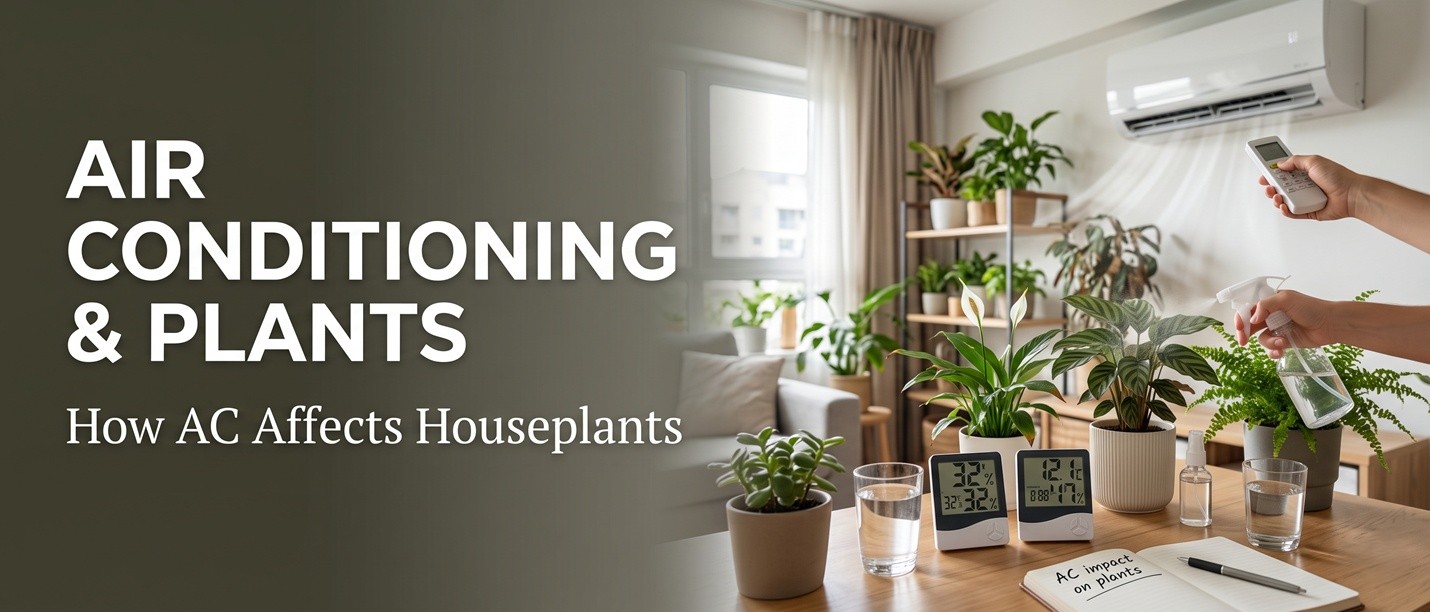
What Air Conditioning Actually Does to Air
Air conditioning does two things simultaneously: it cools the air and it removes moisture from it. The moisture removal is not a side effect — it is fundamental to how AC works. Warm air holds more water vapor than cool air, so when the AC coil cools warm room air, water condenses on the coil the same way it condenses on a cold glass in summer. That condensate drains out through the AC's drip line, and the air that returns to the room is both cooler and drier than what went in.
A typical AC-cooled room in summer runs at 30-45 percent relative humidity, compared with 55-70 percent in a naturally ventilated room. For humans this is comfortable. For tropical houseplants, which evolved in rainforest understories at 70-90 percent humidity, it is borderline hostile. The good news is that most houseplants can adapt to lower humidity if you manage the other stresses — temperature swings and direct airflow — and pick species that tolerate dry air naturally.
💡 Tip
If you want to know exactly how dry your AC makes the room, spend $15 on a hygrometer. Place it next to your plants and check it morning and night for a week. You may be surprised at how low the humidity drops, and you will know whether you need to add a humidifier or simply pick tougher plants.
The Three AC Stresses on Plants
Air conditioning stresses plants through three distinct mechanisms, and effective care means understanding which one is causing the problem you see. The first is low humidity, which causes brown crispy leaf edges and slow growth. The second is direct cold airflow from a vent, which causes localized chilling injury — patches of translucent or brown tissue on the side of the plant facing the vent. The third is temperature swing, where the plant experiences 22°C during the day and 16°C at night when the AC thermostat drops, which slows metabolism and can cause leaf drop in sensitive species.
These stresses do not act equally. A plant next to an AC vent suffers from all three; a plant across the room only suffers from low humidity. This is why placement matters so much more than species selection in an AC-cooled home. A sensitive plant in a good spot will outperform a tough plant directly in the airflow.
Symptoms and their likely AC-related cause:
- Brown crispy leaf edges on otherwise healthy leaves → low humidity.
- Brown patches on the side of the plant facing the vent → direct cold airflow damage.
- Sudden leaf drop, especially lower leaves → temperature swing between day and night.
- Slow growth, small new leaves → chronic low humidity and lower temperature.
- Yellowing leaves that feel soft → overwatering encouraged by slow evaporation in cool air.
- Sticky residue on leaves or webbing in leaf joints → pest outbreak, often triggered by plant stress.
Plants That Handle AC Well
The plants that thrive in AC-cooled rooms tend to share a few traits: thick or waxy leaves that resist water loss, origins in seasonal subtropical (not equatorial tropical) climates, and an ability to tolerate temperature swings. Snake plants and ZZ plants are the easiest choices — they evolved in regions with dry seasons and are well-equipped for low humidity. Pothos and philodendrons are also reliable, with waxy leaves that hold moisture well.
Most AC-tolerant houseplants:
- Snake Plant (Sansevieria) — handles dry air and temperature swings equally well.
- ZZ Plant (Zamioculcas zamiifolia) — virtually immune to AC stress.
- Pothos (Epipremnum aureum) — waxy leaves resist moisture loss.
- Rubber Plant (Ficus elastica) — thick leaves buffer it against low humidity.
- Heartleaf Philodendron — same waxy-leaf strategy as pothos.
- Chinese Evergreen (Aglaonema) — bred for indoor toughness.
- Jade Plant (Crassula ovata) — succulent, stores its own water.
- Cast Iron Plant (Aspidistra elatior) — tolerant of every indoor stress.
- Dracaena species — marginata and fragrans both tolerate AC.
- Chinese Money Plant (Pilea peperomioides) — surprisingly tough despite thin leaves.
Plants That Struggle in AC Rooms
On the other end of the spectrum, plants from constantly humid tropical forests struggle badly in AC environments. Calatheas, marantas, fittonias, and most ferns evolved for the rainforest floor where humidity rarely drops below 70 percent and temperatures are stable year-round. In an AC-cooled room they will develop brown crispy leaf edges within weeks, even with regular misting. You can keep them alive with a dedicated humidifier and a humidity tent, but the maintenance load is high and they will never look as good as they would in a naturally humid room.
Plants that hate drafts are equally risky. Ficus trees (including the popular benjamina and lyrata varieties) react to AC airflow by dropping leaves, sometimes dramatically — a single week of cold airflow can strip a ficus of half its canopy. If you must keep a ficus in an AC room, place it well away from any vent and shield it from direct airflow with furniture or screens.
⚠️ Warning
Never place a Calathea, Maranta, Fittonia, or maidenhair fern directly in the path of an AC vent. The combination of cold airflow and low humidity will brown the leaf edges within days, and the damage is irreversible — once the edge is brown, only new growth will replace it. Move the plant, add a humidifier, or accept that this is the wrong species for the location.
Positioning Plants in an AC Room
The single most important rule for AC rooms is: never place a plant in the direct airflow from a vent. AC supply vents blow air at 1-3 meters per second, which is enough to chill plant tissue several degrees below the surrounding air and to accelerate transpiration well beyond what the plant can replace. Walk around your room and feel for airflow with a damp hand — anywhere you feel a noticeable breeze is a bad plant spot.
The best spots are usually 1-2 meters from any vent, near a window for natural light but not directly under a supply duct. If you must place a plant under a vent, install a vent deflector (a $5 plastic attachment that redirects airflow along the ceiling) so the cold air does not blow straight down onto the plant. This is one of the most cost-effective plant-care purchases you can make.
💡 Tip
Group plants together in AC rooms. A cluster of 5-6 plants creates a localized humidity microclimate that is 5-10 percent higher than the surrounding room. Combined with a pebble tray or a small humidifier, this can raise the immediate area to 50-55 percent humidity even in a heavily air-conditioned space.
Humidity Solutions Beyond the Humidifier
A room humidifier is the most effective solution for AC-dry air, but it is not always practical. Pebble trays are a simpler alternative: fill a shallow tray with pebbles, add water to just below the top of the pebbles, and set the plant on top. As the water evaporates, it raises humidity immediately around the plant. The effect is modest (5-10 percent humidity increase within 30 cm of the tray) but it is enough to keep tolerant species happy and to take the edge off for moderately sensitive ones.
Misting is widely recommended but largely ineffective. A fine mist of water on the leaves evaporates in 1-2 minutes in AC air, providing only a brief humidity spike. The plant does not have time to absorb any of the moisture through its leaves. Save yourself the effort and put it into a pebble tray or humidifier instead. The one situation where misting helps is cleaning dust off leaves, which is a separate benefit.
Adjusting Watering for AC Rooms
AC rooms dry out soil more slowly than naturally warm rooms, because the lower temperature reduces evaporation. This catches new plant owners off guard — they expect a plant in a 'dry' room to need frequent watering, but the cool air actually means the soil stays moist longer. The result is overwatering and root rot, the most common AC-room plant killer.
Check soil moisture with your finger before watering, and water only when the top 2-3 cm are dry for most species, or when the soil is completely dry for succulents. This is the same advice as for any plant, but it is especially important in AC rooms because the visual cues (wilting, dry surface soil) can be misleading. A moisture meter is a worthwhile $10 investment for AC-room plant care.




Only logged-in users can comment
Sign in or create a free account to join the conversation — it takes less than a minute.