

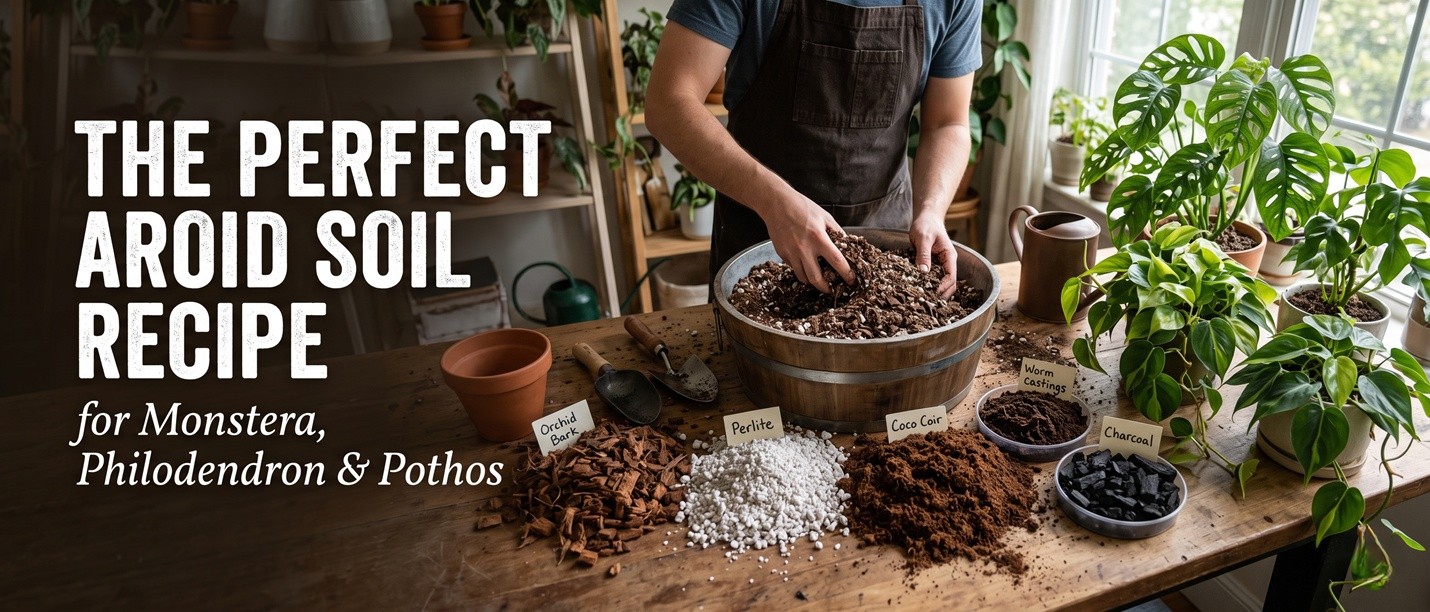
Why Aroids Need a Different Soil
Aroids — the plant family that includes Monstera, Philodendron, Pothos, Aglaonema, Anthurium, and ZZ — evolved as epiphytes and hemi-epiphytes climbing tropical trees. Their roots are adapted to loose, humid, air-filled pockets of leaf litter and bark, not dense garden soil. When you pot one in standard houseplant compost, the fine particles compact around the roots, hold water for too long, and starve the plant of oxygen. The result is chronic overwatering damage, root rot, and the yellowing lower leaves that plague so many Monstera collections.
A proper aroid mix is chunky, airy, and dries out within five to seven days. The roots can breathe between waterings, the plant grows noticeably faster, and problems like fungus gnats almost disappear because the surface no longer stays soggy. Once you switch to this mix, you will find that aroids become some of the most forgiving houseplants you can grow.
💡 Tip
A quick test: water your aroid well, then lift the pot. Three days later, lift it again. If it still feels heavy, your mix is too water-retentive. If it feels noticeably lighter, you are in the right zone.
The Core Aroid Recipe (5 Ingredients)
This is the ratio that works for roughly 90% of indoor aroids. It drains fast enough that you can water generously without risk, but holds enough moisture that the plant is not bone-dry by the next morning. All measurements are by volume, not weight — use a scoop or a pot to measure.
The standard aroid mix:
- 2 parts orchid bark (small chip, 6–10 mm) — creates the chunky open structure
- 2 parts perlite (coarse grade) — adds aeration and prevents compaction
- 1 part coco coir (compressed brick, rehydrated) — light moisture retention without becoming anaerobic
- 0.5 part horticultural charcoal (activated or raw) — sweetens the mix, absorbs toxins, resists fungal growth
- 0.5 part worm castings — slow-release nutrition for the first 6–8 weeks after potting
Mix everything in a large tub or trug with your hands, wearing gloves if your skin is sensitive to perlite dust. The finished mix should look like a coarse, dark granola with visible chunks of bark and white perlite throughout. When you squeeze a handful hard, it should hold together briefly then crumble apart — if it forms a solid ball, add more perlite and bark; if it falls apart instantly without any cohesion, add a touch more coir.
How to Adapt the Recipe to Your Climate
In dry climates (relative humidity below 40%), plants dry out fast and you may find yourself watering every other day. Increase the coir from 1 part to 1.5 parts and reduce perlite slightly to 1.5 parts. The mix will hold moisture an extra day or two without becoming soggy.
In humid climates or over winter when growth slows, do the opposite: drop coir to 0.5 part and bump perlite up to 2.5 parts. The goal is always a mix that dries within a week — adjust the moisture-retaining ingredients to hit that target.
Sensible Substitutions When You Cannot Find Everything
Specialty ingredients are not always available, and you do not need to delay repotting for a perfect shopping list. The structure of the mix matters more than the exact identity of each ingredient. Use these swaps freely:
Common substitutions that work well:
- Pumice instead of perlite — same aeration, heavier so it does not float to the top over time
- Sphagnum peat moss instead of coco coir — slightly more acidic, fine for aroids but less environmentally sustainable
- Cypress mulch or fir bark instead of orchid bark — same chunky structure, often cheaper in bulk
- Rice hulls (parboiled) instead of charcoal — similar porosity and antifungal effect, widely available
- Compost instead of worm castings — slightly hotter, so use only 0.25 part to avoid burning roots
What to Avoid Putting in an Aroid Mix
Just as important as what to include is what to leave out. Standard garden soil, topsoil, and potting soil labeled for outdoor use are too dense and carry soil-borne pathogens. Sand, despite looking like it should improve drainage, actually fills the air pockets between bark chunks and makes the mix denser. Coarse builders' sand is acceptable in cactus mixes but not for aroids.
Avoid pre-fertilized mixes marketed as all-purpose — the fertilizer charge is calibrated for outdoor annuals and can burn aroid roots. Vermiculite is sometimes confused with perlite, but vermiculite holds water rather than creating air pockets and will turn your chunky mix into a brick within a few months.
⚠️ Warning
Never use soil dug from the garden for indoor plants. It is far too heavy, drains poorly, and almost always contains fungus gnat larvae, root-knot nematodes, or weed seeds that will become a permanent problem in your home.
Watering and Repotting Notes for This Mix
When you first pot up in this recipe, water generously until liquid runs freely from the drainage holes. The coir and worm castings need to fully hydrate, which can take two passes with the watering can. After the initial watering, do not water again until the top 5 cm feels dry and the pot has lost its heavy weight.
Because this mix is so well-aerated, aroids can stay in the same pot for 18–24 months before needing a refresh. When you do repot, you will find the roots are firm, white or pale yellow, and growing in a dense spiral — that is the visual confirmation that the mix is doing its job. Black, slimy, or fragrant roots mean the mix has broken down and it is time for a fresh batch.
💡 Tip
Make a double batch and store the unused portion in a sealed bucket. Pre-mixed aroid soil keeps for at least six months, so you always have fresh mix on hand when a plant suddenly needs repotting.



Only logged-in users can comment
Sign in or create a free account to join the conversation — it takes less than a minute.