

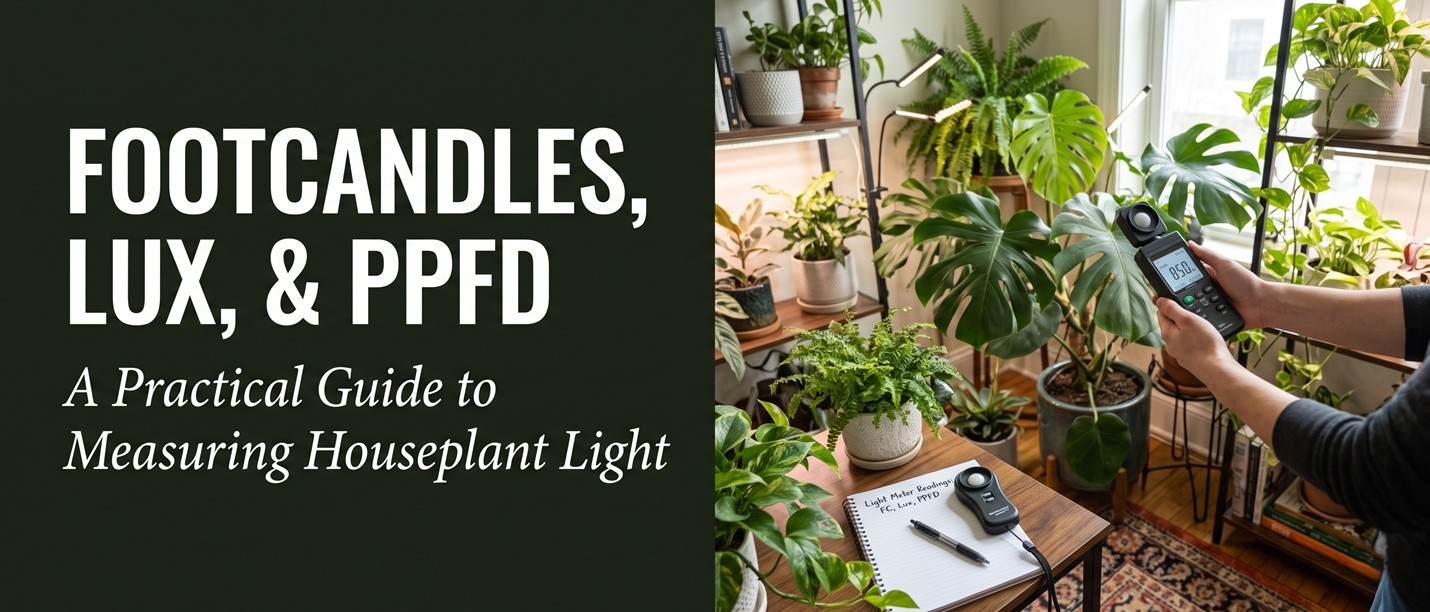
Why Visual Light Estimates Are Wrong
Human eyes are terrible at estimating light levels. They adapt to a huge range of brightness — from candlelight to bright sunlight — and our perception is constantly adjusted by our pupils and brain. A room that 'looks bright' to you might have 5% of the light a plant needs. The result is that most houseplants are chronically light-starved, and their owners do not realize it until the plant declines.
Light is the energy source for photosynthesis. Without enough of it, the plant cannot grow, cannot defend itself against pests, and cannot bloom. Most houseplant problems — slow growth, leggy stems, yellowing leaves, susceptibility to fungal infections — are fundamentally light problems. Before adjusting watering, fertilizer, or humidity, measure the light. Chances are, that is where the problem lies.
💡 Tip
A single afternoon spent measuring the light in every spot where you have plants will improve your houseplant care more than any other single intervention. Once you know which spots get 200 lux versus 2,000 lux versus 20,000 lux, you can place every plant where it will actually thrive.
Three Units of Light Measurement
Light is measured in three different units depending on context. Understanding the differences will help you make sense of plant care advice that uses any of them.
Three light measurement units used in horticulture:
- Footcandles (fc) — the traditional horticulture unit, based on the light of one candle at one foot. Simple and intuitive; common in older houseplant books.
- Lux — the metric equivalent, based on lumens per square meter. 1 footcandle ≈ 10.76 lux. More common in scientific literature and outside North America.
- PPFD (Photosynthetic Photon Flux Density) — measures only the wavelengths plants actually use for photosynthesis, in micromoles per square meter per second. Most accurate but requires a specialized meter; common in commercial grow operations and LED light specifications.
For home growers, footcandles or lux are sufficient. PPFD becomes important if you are using grow lights, where the spectrum is engineered and you want to confirm the light is reaching the plant at useful intensity. For evaluating natural light from windows, footcandles and lux work fine, and any modern light meter (including phone apps) can measure them.
How to Measure Light Without Buying a Meter
Dedicated light meters cost $30–300 and are accurate but unnecessary for most home growers. Several free or inexpensive phone apps use the phone's built-in ambient light sensor (the same one that adjusts screen brightness) to measure light levels. The accuracy is reasonable for houseplant purposes — within 10–20% of a professional meter, which is plenty accurate for placing plants.
Good options include 'Lux Light Meter' (iOS and Android), 'Photone' (iOS, designed for horticulture), and 'Light Meter' by David Quentin (Android). The procedure is simple: open the app, hold the phone where the plant sits (with the screen facing the light source, not facing you), and read the number. Take readings at different times of day — morning, noon, late afternoon — to understand how the light changes through the day.
⚠️ Warning
Phone light sensors are calibrated for visible light, not photosynthetically active radiation. They underestimate red and far-red light and overestimate green light. For sunlight and most LED bulbs the error is small enough not to matter for placement decisions, but for specialized red/blue LED grow lights the readings will be very inaccurate.
Light Levels for Different Plant Categories
Houseplant care guides typically divide light into 'low,' 'medium,' and 'bright indirect.' These translate to measurable ranges in footcandles and lux. The numbers below are minimums for sustained growth — plants tolerate less for short periods but will not thrive long-term below these thresholds.
Light level ranges and the plants that need them:
- Low light: 50–250 footcandles (500–2,500 lux) — minimum for survival of ZZ, snake plant, pothos, Chinese evergreen, cast iron plant
- Medium light: 250–1,000 footcandles (2,500–10,000 lux) — supports growth of philodendron, peace lily, dracaena, ferns, prayer plants
- Bright indirect: 1,000–2,500 footcandles (10,000–25,000 lux) — ideal for Monstera, fiddle leaf fig, rubber plant, most aroids
- Very bright indirect / light direct sun: 2,500–5,000 footcandles (25,000–50,000 lux) — ideal for succulents, cacti, hibiscus, citrus
- Full direct sun: 5,000–10,000 footcandles (50,000–100,000+ lux) — only for full-sun plants like cacti, succulents, and Mediterranean herbs
To put these numbers in perspective: direct noon sunlight is around 10,000 footcandles (100,000 lux). A south-facing window with no obstructions lets in about 4,000–6,000 footcandles at the glass, dropping to 1,000–2,000 a meter back. An east window gets 1,500–3,000 footcandles at the glass. A north window rarely exceeds 500 footcandles. Office fluorescent lighting at desk height is typically 100–200 footcandles — enough to keep a snake plant alive but not enough to grow much of anything.
How to Use the Measurements
Once you have measured the light in each spot where you might place a plant, the matching becomes straightforward. Look up the light preference of each plant in your collection, then place plants in spots that meet or slightly exceed their needs. A plant in slightly more light than it 'needs' will grow better than one in slightly less, so when in doubt, choose the brighter location.
Re-measure seasonally. Light levels drop dramatically in winter as the sun angle lowers and days shorten. A spot that measures 1,500 footcandles in July might measure 600 in December — moving the plant from a south window to an east window, or adding a grow light, becomes necessary. Without measurement, you will only discover this when the plant starts dropping leaves in January; with measurement, you can preempt the problem.
💡 Tip
Take readings at the same time of day each season — mid-morning is a good compromise between morning and afternoon light. Note the readings on a simple map of your home and you have a permanent guide to plant placement that updates with the seasons.
Common Surprises When You Start Measuring
Most people are surprised by how little light their plants actually receive. A room that 'feels bright' through human eyes often measures 200–400 footcandles — adequate only for the lowest-light plants. A spot 2 meters back from a south window, which looks bright because you can see the window, often measures under 500 footcandles because light falls off rapidly with distance.
Another common surprise is the difference between morning and afternoon light. An east window may measure 2,000 footcandles at 9 AM and 300 footcandles at 3 PM. The plant averages about 800 footcandles over the day, which is enough for many plants but not the 'bright indirect' you might assume from the morning reading alone. Measure at multiple times to understand the daily light integral, which is what the plant actually experiences.
Sheer curtains and window screens cut light by 30–60% — far more than most people expect. If your plant is struggling behind a sheer curtain, measure both with and without the curtain to see the difference. Often the solution is simply pulling the curtain aside during the day or moving the plant to a window without a curtain.


Only logged-in users can comment
Sign in or create a free account to join the conversation — it takes less than a minute.