

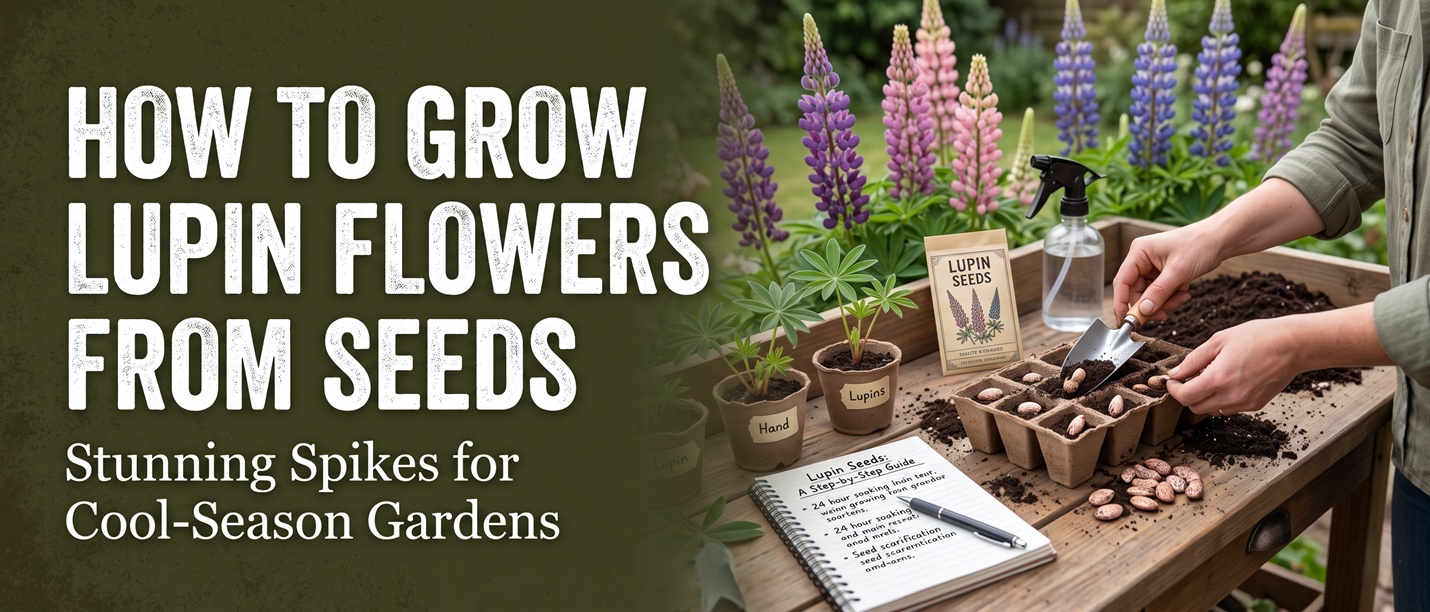
What Makes Lupins Special in the Garden
Lupins (Lupinus) are a genus of legumes in the pea family, native to the Americas and the Mediterranean. While some species are grown for their edible seeds (sweet lupins), most gardeners grow them for their spectacular flower spikes — 60 to 120 centimeters tall, densely packed with pea-like blooms in virtually every color except true green. The Russell hybrid lupins, bred in the early 20th century, are the most popular ornamental type and produce bi-color and tri-color spikes that stop traffic in late spring.
Beyond their beauty, lupins are nitrogen-fixers — symbiotic bacteria in their root nodules convert atmospheric nitrogen into plant-available forms, improving soil fertility for neighboring plants. They are also deer-resistant (the fuzzy leaves and alkaloid content make them unpalatable), attractive to bees and butterflies, and excellent cut flowers with a vase life of 5 to 7 days. Lupins are short-lived perennials (4 to 6 years), but they self-seed readily and a single planting can persist for decades as older plants die and seedlings replace them.
💡 Tip
If you live in a hot climate (summers above 35 degrees Celsius), lupins will struggle. They are cool-climate perennials that need a winter chill to flower well and resent heat. In warm climates, treat them as winter annuals — sow in October, enjoy flowers in February to April, and compost the plants when heat arrives. The same applies to humid tropical climates, where fungal disease finishes them off by mid-summer.
Scarifying Seeds for Tripled Germination
Lupin seeds have a hard, impermeable seed coat that prevents water from entering. In nature, this coat is broken by freezing, thawing, and abrasion in soil over winter. Untreated lupin seeds sown directly often have germination rates of 20 to 30 percent. Two simple pre-treatments can raise this to 80 percent or higher: scarification and soaking.
Scarification means deliberately damaging the seed coat. The easiest method for lupins is to nick each seed with a sharp knife or rub it with sandpaper until you see a faint lighter spot on the coat (do not cut deeply into the seed). Alternatively, soak the seeds in hot (not boiling) tap water — about 70 degrees Celsius — for 24 hours. The seeds that have absorbed water will swell to 2 to 3 times their original size; these are ready to sow. Any seeds that have not swollen after 24 hours can be scarified with a knife and soaked for another 12 hours.
⚠️ Warning
Lupin seeds are toxic if eaten — they contain alkaloids that cause breathing difficulty and convulsions. Keep seeds out of reach of children and pets, and wash your hands after handling. The toxicity applies mainly to seeds and young plants; mature Russell hybrid lupins have been bred for low alkaloid content and the ornamental flowers are not a hazard.
Sowing and Transplanting
Lupin seeds can be sown directly in the garden or started indoors 6 to 8 weeks before the last frost. Direct sowing is simpler and produces sturdier plants, but germination is slower (14 to 21 days) and seedlings are vulnerable to slugs and snails. Indoor sowing gives better control and earlier blooms, but lupins have long taproots and resent transplanting — use deep pots or biodegradable cells that can be planted whole.
Sow seeds 6 millimeters deep in a free-draining seed mix (one part coir, one part perlite, one part compost). Water gently and keep at 18 to 22 degrees Celsius. Germination in 10 to 21 days. Once seedlings have their first true leaves, transplant into individual 9-centimeter pots using a slightly acidic potting mix (add a handful of pine bark or peat to standard mix). Harden off for 7 to 10 days before transplanting to the garden. Plant 45 to 60 centimeters apart in rich, slightly acidic soil (pH 5.5 to 6.5) in full sun or light afternoon shade.
Soil, Sun, and Water
Lupins prefer slightly acidic soil (pH 5.5 to 6.5) and will suffer in alkaline soils above pH 7.5, where they develop chlorosis (yellow leaves with green veins) due to iron deficiency. If your soil is alkaline, dig in acidic amendments — pine needles, peat moss, coffee grounds, or elemental sulfur — at planting time. Lupins also need excellent drainage; the crown rots easily in wet soil. Heavy clay is not suitable; raised beds or large containers with gritty mix are the answer in clay gardens.
Full sun produces the strongest flower spikes, but in hot-summer regions, light afternoon shade extends the bloom period. Water young plants regularly — 2 to 3 liters per plant every 3 to 4 days — until they are established (about 8 weeks). Mature lupins are surprisingly drought-tolerant thanks to their deep taproot, but dry spells during flowering cause bud drop. A 5-centimeter mulch of compost or bark keeps roots cool and moist. Avoid high-nitrogen fertilizer — lupins fix their own nitrogen, and excess nitrogen produces leafy growth with no flowers.
💡 Tip
Do not move established lupins. Their taproot can extend 60 centimeters or more into the soil, and any attempt to transplant a mature plant will kill it. If you need to relocate a lupin, do it in early spring before growth starts, dig as deep a root ball as possible, and accept a 50 percent chance of failure. It is often easier to start a new plant from seed in the new location.
Deadheading and the Second Flush
Lupins produce their main flush of flowers in late spring to early summer, lasting 3 to 4 weeks. If you deadhead the spent spikes promptly — cutting them down to the basal foliage before seed pods form — the plant will often produce a smaller second flush in late summer. This second flush is shorter (2 weeks) and has fewer spikes, but extends the season significantly. Allowing seeds to form ends flowering for the year and signals the plant to begin dormancy.
After the second flush, leave any remaining flower spikes to set seed if you want seedlings next year. The seed pods turn brown and split explosively in late summer, scattering seeds 1 to 2 meters from the parent. Seedlings that emerge the following spring may or may not resemble the parent — Russell hybrid lupins do not come true from seed, and you will get a range of colors, often including muddy purples and whites. For consistent colors, propagate by basal cuttings taken in early spring.
Pests, Diseases, and Overwintering
Lupins have two major pest problems. Slugs and snails devour young seedlings in spring — protect with organic slug pellets, copper tape around pots, or by raising seedlings indoors until they are 10 centimeters tall, at which point they are too tough for slugs. Aphids cluster on the flower spikes in late spring and can distort the blooms. Spray off with a strong jet of water, or treat with insecticidal soap if the infestation is heavy. Encourage ladybirds and lacewings, which keep aphids in check naturally.
The main disease is lupin anthracnose, a fungal infection that causes stems to bend and break at the crown in wet weather. Prevent by spacing plants for good airflow, avoiding overhead watering, and removing infected stems promptly. Crown rot is a problem in poorly drained soil — the entire plant collapses suddenly in late spring. There is no cure; remove and destroy infected plants and improve drainage before replanting. Established lupins tolerate winter cold to -25 degrees Celsius with no protection; in colder regions, mulch the crown with 10 centimeters of straw in late autumn.





Only logged-in users can comment
Sign in or create a free account to join the conversation — it takes less than a minute.