

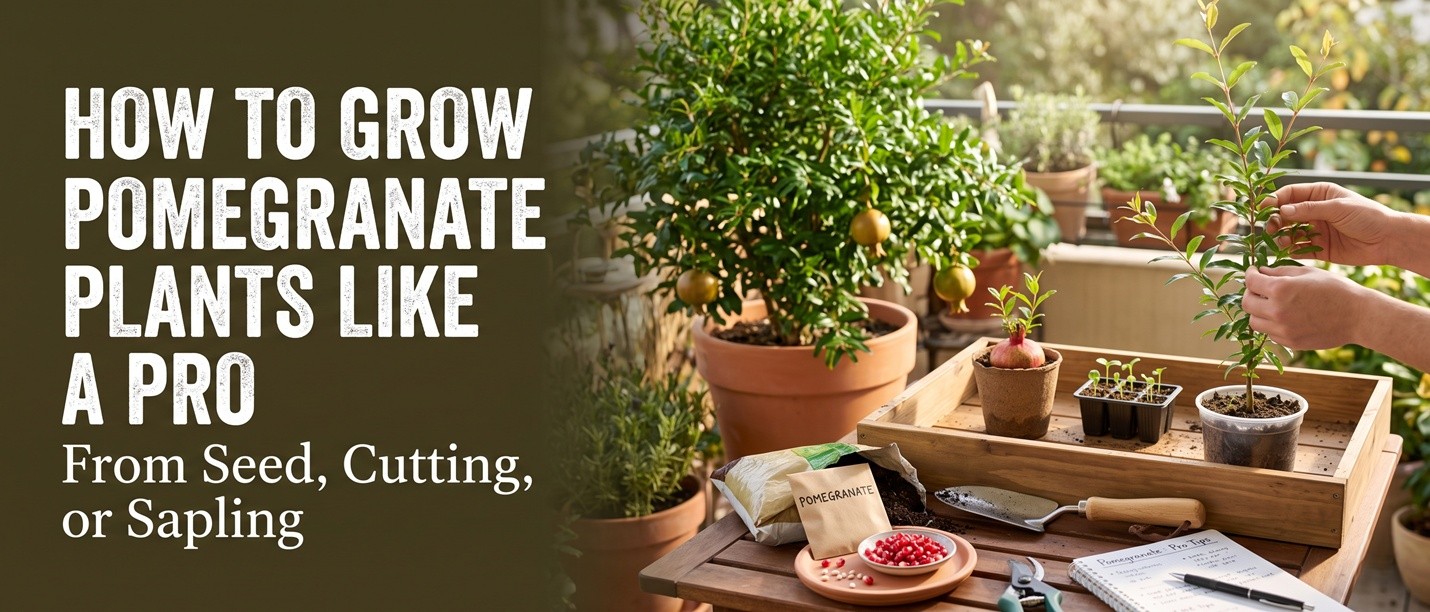
Why Pomegranates Are Almost the Perfect Backyard Fruit Tree
Pomegranate (Punica granatum) is a deciduous shrub or small tree native to Iran and the Himalayan foothills, cultivated for at least 5,000 years. It thrives in hot, dry summers and cool winters, making it ideal for most of India and similar subtropical climates. Unlike most fruit trees, pomegranates are self-fertile (one plant is enough), drought-tolerant once established, and resistant to most pests and diseases. They fruit within 3 to 4 years of planting and continue productive for 30 to 40 years, with some specimens living over 100 years.
The plant is also stunningly ornamental. The trumpet-shaped orange-red flowers appear in late spring and continue for 6 to 8 weeks; the glossy narrow leaves turn golden yellow in autumn; and the fruit hangs on the plant like Christmas ornaments from September to December in the Northern Hemisphere. A mature pomegranate in full fruit is one of the most beautiful sights in any edible garden. The only real challenge is fruit splitting and bird predation — both manageable with a few specific practices covered below.
💡 Tip
If your goal is fruit, buy a named cultivar from a nursery rather than growing from seed. Seed-grown pomegranates take 5 to 7 years to fruit and may produce sour or mediocre fruit. Named cultivars like Ganesh, Bhagwa, Ruby, or Mridula fruit in 3 years and reliably produce sweet, large arils. Growing from seed is rewarding as an experiment but rarely produces fruit as good as the parent.
Three Ways to Start a Pomegranate Plant
Pomegranate can be started from seed, from hardwood cuttings, or from nursery saplings. Each has trade-offs. Seeds are easy and free but produce variable offspring with a long juvenile period (5 to 7 years to first fruit). Cuttings produce clones of the parent and fruit in 3 years but require access to a known-good mother plant. Nursery saplings are the fastest path to fruit (often fruiting the year after planting) and guarantee the variety, but cost money.
To grow from seed, extract arils from a ripe pomegranate, rinse off the juice, and let the seeds dry overnight. Sow 1 centimeter deep in a moist seed-starting mix, cover with plastic, and keep at 25 to 30 degrees Celsius. Germination in 2 to 6 weeks. Transplant seedlings to individual pots when they have 4 true leaves. To grow from cuttings, take 20-centimeter hardwood cuttings in late winter from last year's growth, dip the cut end in rooting hormone, and plant 10 centimeters deep in a sand-and-compost mix. Cuttings root in 6 to 10 weeks and can be transplanted after 4 to 6 months of growth.
⚠️ Warning
Do not use pomegranate seeds from supermarket fruit if your goal is to grow a productive plant. Most commercial pomegranates are hybrids whose seedlings revert to the wild type — small, sour fruit with hard seeds. Use seeds from a known-good cultivar, or better, buy a grafted or cutting-grown plant of a named variety.
Planting Site and Soil Preparation
Pomegranates need full sun — at least 8 hours of direct sunlight daily. Anything less and the plant will grow but produce few flowers and even fewer fruit. The soil should be well-drained, with a pH between 5.5 and 7.0. Pomegranates tolerate a wide range of soils including sandy, gravelly, and even slightly saline soils, but they will not survive in heavy clay that stays waterlogged. If your soil is heavy clay, plant on a raised mound 30 centimeters high and amend generously with compost and coarse sand before planting.
Dig a hole twice as wide and the same depth as the root ball. Mix one part compost with two parts native soil and backfill. Plant the sapling at the same depth it was in the pot (do not bury the graft union if it is a grafted plant). Water thoroughly after planting and apply a 5-centimeter mulch of compost or wood chips, keeping the mulch 5 centimeters away from the trunk. Space plants 3 to 4 meters apart if planting more than one — pomegranates grow into 3-meter shrubs if unpruned.
Training as Shrub or Tree
Pomegranate naturally grows as a multi-stemmed shrub, but it is easily trained as a single-trunk small tree. The shrub form is easier and produces more fruit per plant, but takes more space and makes harvesting harder. The tree form is more elegant and space-efficient but requires more pruning. Choose the form based on your space and aesthetic preference, and start training in the first year after planting.
For a shrub, allow 3 to 5 main stems to grow from the base, removing all others. Each year, remove dead, diseased, and crossing branches, and thin the canopy lightly to allow light and air penetration. For a tree, select one strong upright stem as the trunk, remove all others, and pinch out the growing tip when the trunk reaches 60 to 80 centimeters. This forces lateral branches to form the canopy. Select 3 to 4 well-spaced branches as the main scaffold, removing others. Each year, prune to maintain an open vase shape with the center clear.
💡 Tip
Pomegranate fruits on the tips of new growth from the previous season. When pruning, never remove more than one-third of last year's growth, or you will remove the fruiting wood. Suckers (vigorous shoots from the base) should be removed promptly — they sap the plant's energy and rarely produce fruit.
Watering for Sweet Fruit
Pomegranates are drought-tolerant once established, but consistent watering produces larger, sweeter fruit. For the first year after planting, water deeply once a week. From the second year, water once every 10 to 14 days during dry periods. Mature trees (5 years and older) need watering only during prolonged drought — every 3 to 4 weeks. The plant tells you when it is genuinely thirsty by curling its leaves inward; do not water before this happens.
The critical watering window is during fruit development, from fruit set to about 2 weeks before harvest. During this period, the soil should be evenly moist — any dry spell causes the fruit to split when water resumes. Split fruit is the single biggest cause of crop loss in home pomegranates. Reduce watering gradually as harvest approaches to allow the fruit to sweeten and the skin to thicken. Stop watering entirely 2 weeks before expected harvest.
⚠️ Warning
Uneven watering is the cause of split pomegranates, not overwatering per se. The fruit expands rapidly after a dry spell and the skin cannot keep up, causing it to crack. Once split, the fruit is still edible but attracts pests and rots within days. Prevent splitting by maintaining even soil moisture during fruit development — drip irrigation is ideal — and by harvesting promptly when the fruit is ripe rather than leaving it on the tree.
Fertilizing and Pest Management
Pomegranates are light feeders. Apply 2 to 3 kilograms of well-rotted compost or farmyard manure per plant in early spring, plus 50 grams of bone meal and 25 grams of a balanced NPK fertilizer. Avoid high-nitrogen feeds — they produce lush leafy growth at the expense of fruit, and increase fruit splitting. A foliar spray of 0.5 percent zinc sulfate and 0.5 percent boric acid in spring corrects common micronutrient deficiencies that cause yellow leaves and poor fruit set.
Pests are minimal. The most common is the pomegranate butterfly (Deudorix isocrates), whose larvae bore into the fruit. Prevent by bagging individual fruit with paper or cloth bags when they are golf-ball sized, or by spraying neem oil every 2 weeks during fruit development. Aphids and mealybugs can infest new growth in spring — spray off with water or treat with insecticidal soap. Fungal fruit rot is prevented by avoiding overhead watering and by removing and destroying any split or rotten fruit immediately.
Harvesting at Peak Ripeness
Pomegranates do not ripen after harvest — they must be picked fully ripe. The fruit takes 5 to 7 months from flower to harvest, ripening from August to December in most Indian climates. The signs of ripeness are: a deep color change (red varieties turn deep red, yellow varieties turn golden yellow), a metallic sound when tapped (a ripe fruit sounds like a wooden block; an unripe fruit sounds dull and thuddy), and a slight flattening of the crown as the arils push outward against the skin.
Cut the fruit from the plant with sharp secateurs, leaving a 1-centimeter stem attached — do not pull, as pulling damages the plant and the fruit. Handle carefully; pomegranates bruise easily and bruises cause rapid spoilage. The fruit keeps at room temperature for 1 to 2 weeks, or in the refrigerator for 2 to 3 months. The arils can be extracted and frozen for up to 12 months — spread them in a single layer on a tray, freeze, then transfer to a freezer bag. Juiced and frozen, pomegranate keeps for 18 months with minimal flavor loss.








Only logged-in users can comment
Sign in or create a free account to join the conversation — it takes less than a minute.