

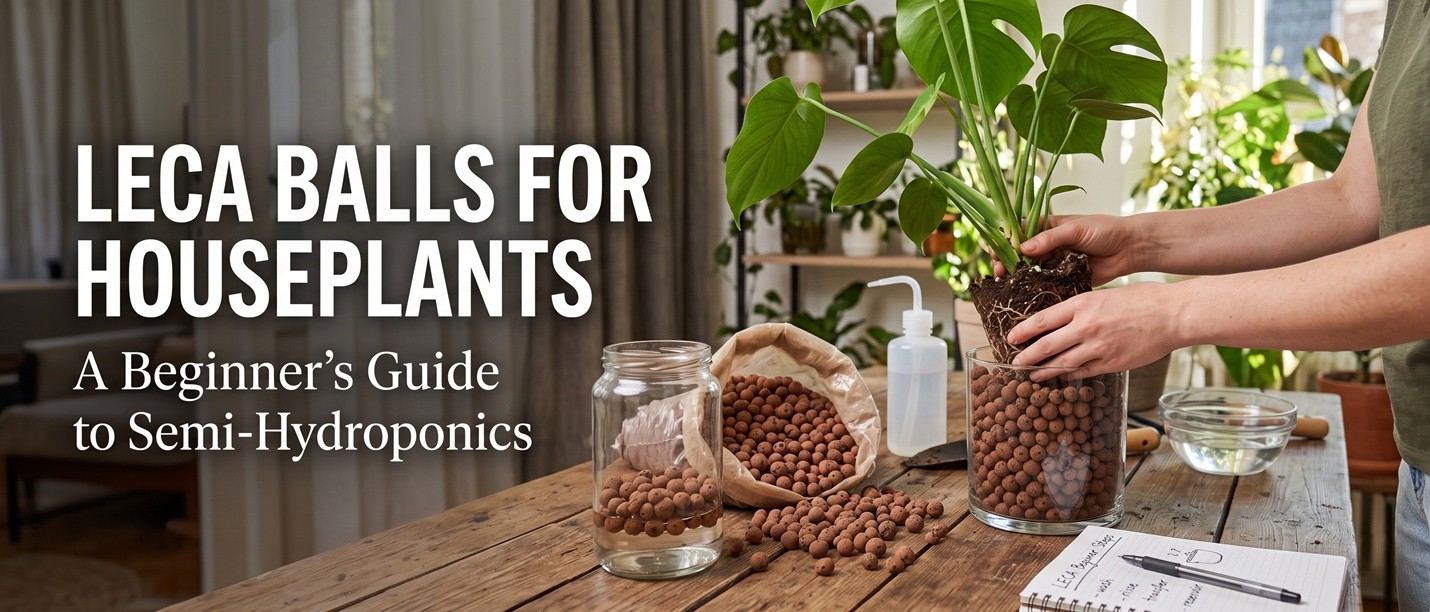
What Is LECA and Why Are Plant People Obsessed With It?
LECA stands for Lightweight Expanded Clay Aggregate, which is a fancy name for round clay pebbles that have been fired in a kiln until they pop like popcorn. The result is a sterile, pH-neutral, reusable growing medium that holds moisture in its pores while letting air circulate freely around plant roots. Plant owners discovered that LECA solves two of the biggest pain points of soil growing: fungus gnats and inconsistent watering.
Semi-hydroponics — growing plants in LECA with a reservoir of nutrient solution at the bottom of the pot — has exploded in popularity over the last five years. The technique was originally developed for commercial orchid and foliage production, but hobbyists have adapted it for nearly every common houseplant. Once a plant is established in LECA, you only need to refill the reservoir every 1-2 weeks and flush the system monthly. No more guessing whether the soil is dry, no more fungus gnat infestations, and no more repotting every year as soil breaks down.
💡 Tip
LECA is reusable essentially forever. If you switch a plant back to soil or lose a plant, you can rinse the LECA, soak it in a 10 percent bleach solution for 30 minutes, rinse again, and use it for another plant. A one-time $25 bag of LECA can serve dozens of plants over many years, which makes the upfront cost reasonable compared to repeatedly buying potting soil.
How Semi-Hydroponics Actually Works
Semi-hydroponics relies on three physical principles: capillary action, root adaptation, and nutrient solution management. Capillary action is the same force that makes a paper towel soak up water — the porous LECA pebbles wick moisture upward from the reservoir at the bottom of the pot, delivering it to the root zone. The pebbles are large enough that air pockets remain between them, so roots get both moisture and oxygen simultaneously, which is the holy grail of plant growing.
Root adaptation is the second key. Soil roots and water roots are structurally different — soil roots are thinner, hairier, and adapted to extract moisture from a solid medium, while water roots are thicker, smoother, and adapted to absorb nutrients directly from solution. When you move a plant from soil to LECA, the existing soil roots usually die and rot, and the plant must grow new water-adapted roots. This transition period, which takes 4-8 weeks, is when most LECA conversions fail. Patience and consistent reservoir management are essential.
Nutrient solution management is the third pillar. Soil contains trace minerals and organic matter that feed plants slowly; LECA contains nothing. You must add a complete hydroponic nutrient solution to the reservoir every time you refill. The solution must contain nitrogen, phosphorus, potassium, calcium, magnesium, sulfur, iron, manganese, zinc, copper, boron, and molybdenum — all in the correct ratios and at the correct pH. This sounds intimidating but in practice you just buy a bottle of complete hydroponic nutrient and follow the dilution instructions.
Which Plants Convert Easily to LECA
Not every plant converts to LECA successfully, and choosing the right plant for your first attempt is the single biggest predictor of success. Plants that thrive in LECA tend to be tropical foliage plants with aggressive root systems — they push out new water-adapted roots quickly and recover from the soil-root die-off without stress. Plants that struggle in LECA are usually those with delicate roots, succulents adapted to dry conditions, or plants that depend on soil microbiome for nutrient uptake.
Plants that convert easily to LECA (beginner-friendly):
- Pothos (Epipremnum aureum) — roots aggressively, very forgiving of transition
- Philodendron (trailing and self-heading varieties) — fast new root growth
- Monstera deliciosa and adansonii — strong rooters, dramatic in clear pots
- Spider plant (Chlorophytum comosum) — roots are naturally adapted to wet conditions
- Tradescantia and inch plant — roots within days of transfer
- Syngonium (arrowhead plant) — very reliable LECA convert
- Aglonema and Dieffenbachia — tropical aroids that appreciate consistent moisture
- Peace lily (Spathiphyllum) — loves the constant moisture LECA provides
- Anthurium — roots beautifully in LECA with high humidity
- Most ficus species (especially Ficus lyrata and elastica)
⚠️ Warning
Do NOT try to convert succulents, cacti, snake plants, or ZZ plants to LECA as a beginner. These plants evolved for dry conditions and their roots rot easily in constantly moist media. Hoya and other semi-succulent vines are also risky. Stick to moisture-loving tropicals for your first 5-10 LECA conversions before attempting drought-tolerant species.
Supplies You Need to Get Started
Setting up a LECA system requires a small upfront investment in supplies, but most items are one-time purchases that last years. The core supplies are LECA pebbles themselves, a nutrient solution designed for hydroponics, a pH testing kit (either drops or a meter), a set of net pots or cache pots with no drainage hole, and a digital scale for measuring nutrients by weight. Optional but helpful supplies include a pH down solution (usually phosphoric acid) and a TDS (total dissolved solids) meter for measuring nutrient strength.
LECA pebbles come in different sizes, typically 8-16 mm or 10-20 mm. The smaller size is better for small plants and propagation; the larger size works better for mature plants. Generic hydroponic nutrient solutions like General Hydroponics Flora Series or Dyna-Gro Grow work well for most houseplants. Avoid orchid-specific fertilizers because they are formulated for bark media and may not have all the nutrients houseplants need in LECA.
Step-by-Step: Converting a Plant from Soil to LECA
Start with a healthy, well-established pothos or philodendron — these convert reliably and let you build confidence before tackling trickier species. Choose a plant you would not mind losing if the conversion goes badly; even with good technique, 10-15 percent of conversions fail. Water the plant thoroughly the day before conversion so the roots are hydrated and pliable.
Conversion steps:
- Remove the plant from its pot and gently shake off loose soil. Soak the root ball in room-temperature water for 10 minutes to loosen compacted soil.
- Rinse the roots thoroughly under running water, working the soil out with your fingers. Be patient — every bit of soil must come out, or it will rot in the LECA.
- Trim any dead, soft, or mushy roots with sterilized scissors. Healthy roots are firm and white or pale tan.
- Soak the LECA pebbles in water for 2-4 hours before use. Dry LECA floats and repels water initially; soaking saturates the pores.
- Place a 2-3 cm layer of soaked LECA in the bottom of a net pot or cache pot.
- Hold the plant in the pot at the desired height and gently fill around the roots with more LECA pebbles. Tap the pot to settle the pebbles between roots.
- Fill the reservoir (bottom third of the pot) with nutrient solution at half-strength. The water level should be just below the root ball.
- Place the pot in a warm, bright spot out of direct sun. Mist the leaves daily for the first week to reduce transpiration stress.
The Transition Period: Weeks 1-8
The first 4-8 weeks after conversion are the critical period. The existing soil roots will mostly die and rot, and the plant must grow new water-adapted roots before it can absorb nutrients effectively. During this time, the plant will look unhappy — leaves may yellow, droop, or drop, and the LECA may develop a slight smell as the old roots decompose. This is normal and not a sign that the conversion has failed, but you must manage the reservoir carefully to prevent the rot from spreading.
During the transition, change the reservoir water every 5-7 days instead of just topping it off. Use quarter-strength nutrient solution for the first 4 weeks, then half-strength for the next 4 weeks, then full strength once the plant has pushed out new white roots into the LECA. Smell the reservoir each time you change it — a sour or sulfurous smell means roots are rotting and you should change the water more frequently. Once the plant has new roots growing into the LECA (visible through clear pots or by gently lifting the plant), the worst is over.
⚠️ Warning
If the plant loses more than 30 percent of its leaves during transition, or if the entire root ball rots instead of just the soil roots, the conversion has failed. Pull the plant out, trim all rot, and try rooting it in water first before re-attempting LECA. Some plants simply will not convert from soil to LECA, and it is better to accept this than to keep killing the same plant trying.
Ongoing LECA Maintenance
Once a plant is established in LECA, maintenance is dramatically simpler than soil. Every 1-2 weeks, top up the reservoir with nutrient solution at the correct dilution. Every 4-6 weeks, completely empty the reservoir, rinse the LECA briefly with clean water, and refill with fresh nutrient solution. This flushes out accumulated salts and prevents nutrient lockout. Check pH every 2-4 weeks — the ideal range is 5.5-6.5, and you adjust with pH up or down solutions as needed.
Signs of nutrient issues in LECA show up faster than in soil because there is no buffer. Yellow new growth with green veins means iron deficiency — usually a pH issue rather than missing nutrients. Stunted new growth with dark green older leaves means nitrogen deficiency. Brown leaf tips mean salt buildup — flush the system more frequently. Once you learn to read these signs, LECA lets you respond in hours rather than weeks, which is one of its biggest advantages over soil.
💡 Tip
Label each LECA pot with the date of conversion and the date of the last reservoir change. This takes 30 seconds and saves you from guessing whether a plant needs water or nutrients when you walk by. A piece of masking tape on the pot with a sharpie is all you need.






Only logged-in users can comment
Sign in or create a free account to join the conversation — it takes less than a minute.